


Valentine's Day (Feb. 14)

with ORO VALENTIO

A Celebration of Devotion, Fidelity, and Chosen Love

Valentine’s Day, at its true core, is a celebration of authentic love—a love that is pure, faithful, and sacrificial, not driven by emotion or desire, but grounded in truth and virtue. Far from the shallow and sensualized version so often promoted today, the real meaning of this day is a call to remember that love is not about indulgence or fleeting pleasure, but about the willing gift of self for the good of the other. True love seeks what is eternally best for the beloved, and is always rooted in commitment, chastity, and moral integrity. A little-known fact about Valentine’s Day is that it was originally connected not just with romantic love, but with the Feast of Purification and martyrdom—a day marked by prayer, sacrifice, and chastity, rather than courtship and indulgence. Rather than a day of chocolates and flirtation, the early meaning of Valentine’s Day was one of sacred love, virtue, and often suffering for the sake of truth.
In the United States, Valentine’s Day is observed as a celebration of love not merely felt, but chosen—expressed through devotion, loyalty, and intentional care. While modern customs often emphasize romance and affection, the day’s deeper roots speak to enduring bonds, moral courage, and love upheld through commitment rather than convenience.
Valentine’s Day traces its origin to Saint Valentine, an early Christian martyr traditionally associated with acts of compassion, marriage, and fidelity during a time of persecution. Over centuries, his legacy merged with medieval traditions of courtly love, where affection was expressed through restraint, poetry, and honor. Love was understood not as impulse, but as virtue—something cultivated through patience, sacrifice, and mutual respect.
In American observance, Valentine’s Day carries both intimacy and symbolism. Candles, handwritten notes, shared meals, and simple gifts serve as gestures of presence rather than excess. The day invites couples, families, and friends alike to pause amid winter’s stillness and affirm the relationships that give life meaning—those sustained by trust, tenderness, and enduring care.

Love is Not of Impulse But of Virtue

Saint Valentine’s legacy endures not because of romance alone, but because of fidelity lived under cost. In an age when loyalty carried consequence, love was not sentimental—it was sacrificial. The tradition surrounding Saint Valentine recalls a man who upheld marriage, compassion, and human dignity even when such commitments demanded courage rather than comfort.
This understanding of love stands in quiet contrast to modern haste. Love, as Saint Valentine bore witness, is not sustained by feeling alone, but by action chosen repeatedly and faithfully. It is revealed through patience, protection, and presence—through deeds that endure when words fall short.
Valentine’s Day, seen through this lens, becomes more than celebration. It is a recommitment: to honor love as virtue, to practice devotion with intention, and to recognize that what is most meaningful is often preserved through quiet, steadfast acts of care.
The shift toward associating St. Valentines Day with love and courtship first appeared in the 14th century, during the rise of medieval courtly culture.The key moment came with Geoffrey Chaucer, the famous English poet, who in the 1380s wrote a poem titled “Parlement of Foules” (or Parliament of Birds). In it, he describes birds gathering on St. Valentine’s Day to choose their mates: “For this was on seynt Valentynes day, Whan every foul cometh there to chese his make.” (“For this was on Saint Valentine’s Day, When every bird comes there to choose his mate.”) Chaucer was using the idea of a feast day in mid-February to align with themes of love in nature, likely inspired by the early stirrings of springtime. His poetry combined the Christian feast of St. Valentine with the medieval ideal of courtly love, which emphasized chivalry, longing, and the nobility of romantic affection.

Valentine's Day Traditions to Make Your Own

Chosen Love, Symbolic Gesture, and Intentional Care
💌 Exchanging Written Messages
One of the oldest Valentine’s traditions is the exchange of handwritten notes or letters. Originating in medieval Europe, these messages emphasized poetry, restraint, and sincerity. The written word allowed affection to be expressed thoughtfully—valuing intention over display.

🌹 Giving Flowers (Especially Roses)
Flowers, particularly roses, became associated with Valentine’s Day through classical symbolism and courtly love traditions. Red roses came to signify devotion and sacrifice, while other colors expressed admiration, purity, or friendship. The act of giving flowers reflects love offered outwardly, not merely felt inwardly.

🕯️ Sharing a Meal by Candlelight
A shared meal—often prepared with care or enjoyed in a quiet setting—is a long-standing Valentine’s custom. Candlelight symbolizes attentiveness and presence, transforming an ordinary table into a space of intentional connection.

🎁 Offering Small, Meaningful Gifts
Rather than extravagance, traditional Valentine’s gifts were symbolic and personal tokens, keepsakes, sweets or confections, or handcrafted items. The emphasis was on meaning rather than cost—love expressed through thoughtfulness.

❤️ Symbols of the Heart
Hearts, knots, and intertwined motifs have long represented unity and fidelity. These symbols appeared in medieval art, manuscripts, and jewelry as visual shorthand for enduring affection and mutual commitment.

🕊️ Honoring Saint Valentine
Valentine’s Day is named for Saint Valentine, traditionally remembered as a witness to marriage, fidelity, and love upheld under hardship. In Christian heritage, the day originally emphasized sacrificial love and moral courage, not indulgence.

🤍 Broadening the Meaning of Love
In many modern observances—especially in the United States—Valentine’s Day also honors family bonds, friendship, and acts of kindness and care. This reflects an older understanding of love as relational and communal, not solely romantic.
The unifying thread is that across centuries and cultures, Valentine’s Day traditions share a single principle: Love is best expressed through intention, fidelity, and presence. Whether through words, shared meals, symbolic gifts, or quiet time together, the day invites love to be chosen deliberately and practiced faithfully.
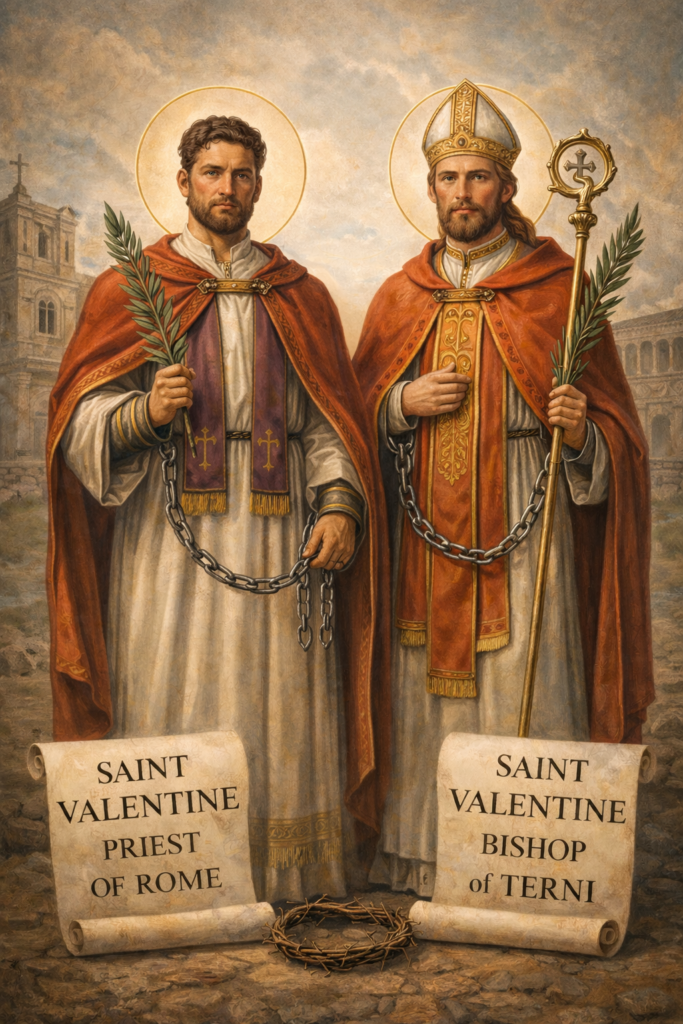
A little-known fact about Valentine’s Day is that multiple saints named Valentine are commemorated on February 14, not just one. The Roman Martyrology—the official catalog of saints—mentions at least two or three different martyrs named Valentine who died in the 3rd century. The most well-known is the priest of Rome, believed to have been executed under Emperor Claudius II, but another was a bishop of Terni, also martyred for his faith. Some sources suggest these may be the same person remembered in different locations, but both are honored. Despite the uncertainty of their exact identities, what unites them is their witness to Christ through martyrdom—not romance. Their memory is elevated not because of any connection to romantic love, but because of their fidelity to God in the face of persecution. This historical detail reminds us that the heart of Valentine’s Day is not about feelings—but about the virtue of love grounded in sacrifice and truth.

“Love is proved by deeds, not by words.”
— attributed to St. Valentine

St. Valentine was a 3rd-century Roman priest and martyr who lived during a time of intense persecution under the Emperor Claudius II. According to tradition, Valentine defied the emperor’s ban on Christian marriage by secretly marrying Christian couples, helping them remain faithful to the Church and to one another. He was also known for his charity, courage, and devotion to the faith, even comforting persecuted Christians and possibly aiding prisoners. For these acts, he was arrested, tortured, and eventually beheaded on February 14, around the year 269 A.D. Before his execution, he is said to have written a letter to the jailer’s daughter, whom he had befriended—and perhaps miraculously healed—signing it, “from your Valentine.” Though many legends surround his life, St. Valentine is honored by the Church as a martyr for Christ and a patron of love, marriage, and fidelity, reminding us that true love is rooted in sacrifice and divine grace.
At its heart, Valentine’s Day is a reminder that love is not sustained by sentiment alone. It is strengthened through attention, renewed through gratitude, and preserved through fidelity. In honoring love as an act of will as much as feeling, the day affirms one of humanity’s most enduring truths: that what is chosen daily becomes what endures.

May love be chosen with intention,
kept with fidelity,
and expressed through patience and care.
May affection deepen into devotion,
and may the bonds we honor today
be strengthened for all the days that follow.

Valentine's Day Cake Decorating Ideas

This section is meant to be more than Cake Decorating Ideas… it’s designed to spark inspiration and creativity, awaken tradition, and infuse your special occasions with style, identity, and atmosphere. A color palette becomes a theme. A design becomes a mood. Simple details—like sugared holly leaves or shimmering stars—can set the tone for a gathering and become part of cherished traditions and lasting memories melded with personal touch and love.

Traditional Valentine's Day Dishes

Valentine’s Day foods served a single purpose: To express affection through care, simplicity, and shared presence. They remind us that love is not amplified by extravagance, but deepened by intention.
🍫 Chocolate & Cocoa Sweets: Chocolate became closely associated with Valentine’s Day in Europe and later in the United States during the 18th–19th centuries.
  • Symbolizes indulgence tempered by affection
  • Historically offered in small, thoughtful quantities
  • Often handmade or carefully selected rather than abundant
Chocolate represents pleasure shared intentionally, not excess.

🍓 Fruits with Romantic Symbolism: Certain fruits were traditionally favored for their symbolism:
  • Strawberries – passion, beauty, and devotion
  • Figs – fidelity and abundance (in older European tradition)
  • Apples – affection and choice
These fruits were often served simply or paired lightly with honey or chocolate.

🍯 Honey & Sweeteners: Honey has ancient associations with love, marriage, and blessing.
  • Used sparingly in desserts or drinks
  • Symbolized sweetness that sustains, not overwhelms
  • Rooted in classical and medieval love symbolism

🍰 Simple Cakes & Baked Goods: Rather than elaborate confections, traditional Valentine’s sweets included:
  • Pound cake
  • Sponge cake
  • Biscuits or shortbread
Often heart-shaped or decorated modestly, these desserts emphasized care over display.

🕯️ Shared Evening Meals: A Valentine’s meal was traditionally intimate and restrained:
  • Home-cooked or quietly shared
  • Simple courses rather than lavish spreads
  • Candlelight to signify attention and presence
The act of sharing mattered more than the menu itself.

🍷 Wine (Moderate & Symbolic): Wine has long symbolized joy, covenant, and shared blessing.
  • Consumed moderately
  • Chosen for quality rather than quantity
  • Reinforced the idea of love as celebration with restraint

Winter Recipes