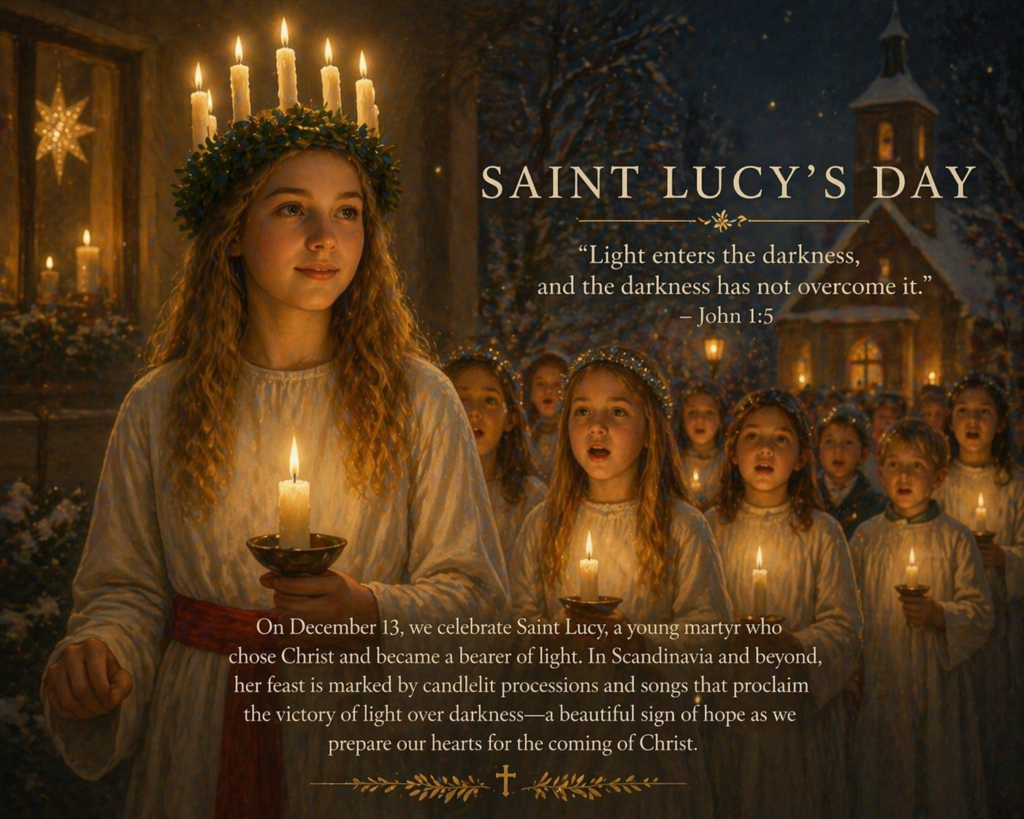




























Saint Lucy's Day

with ORO VALENTIO

December 13th

The feast of Saint Lucy, celebrated each year on December 13, remains a vibrant and deeply meaningful tradition, especially in Scandinavian countries such as Sweden, Norway, Denmark, and parts of Finland. Far from being a forgotten custom, it continues to be widely observed in homes, schools, and churches, where a young girl—often the eldest daughter or a chosen student—is dressed as St. Lucy and crowned with candles, now typically electric for safety. She leads processions of children clothed in white, as groups sing traditional Lucia hymns that center on the theme of light overcoming darkness. This celebration holds particular power in Northern Europe, where December brings long nights, cold weather, and very limited daylight, making the symbolism of light not merely poetic but deeply felt.
The feast retains its clear Christian roots while also flourishing as a shared cultural tradition embraced by people of various backgrounds. It stands today as one of the most enduring and visually striking celebrations connected to a saint, expressing through simple yet profound imagery the triumph of light in the midst of darkness—a message that continues to resonate across generations.

Light that could not be overcome

St. Lucy’s life unfolds as a story of unwavering conviction, quiet strength, and a light that could not be extinguished by the world around her. Born in the city of Syracuse during the late 3rd century, she was raised in a time when being a Christian required both courage and sacrifice. From a young age, Lucy carried within her a deep sense of purpose—one not shaped by comfort or status, but by devotion, purity, and an unshakable alignment with truth.
After the death of her father, Lucy and her mother lived in relative wealth. Yet Lucy saw material possessions not as something to cling to, but as something to steward with intention. She made a private vow of consecration, choosing a life devoted fully to God rather than marriage. According to tradition, she sought the intercession of Saint Agatha for her mother’s healing. When her mother was miraculously restored, Lucy used that moment not for personal gain, but as confirmation of a higher calling. She began giving away her wealth to the poor, investing not in earthly security, but in eternal value.
This decision, however, brought conflict. A suitor—angered by her refusal to marry—betrayed her faith to the authorities during the persecutions under Emperor Diocletian. Lucy was arrested and commanded to renounce her beliefs. She refused with calm certainty. What followed were attempts to break her resolve—efforts to humiliate, move, and ultimately destroy her. Yet tradition recounts that she could not be physically moved against her will, as though anchored by something far greater than human force.
One of the most striking elements of her story is the symbolism tied to her eyes. According to later accounts, Lucy’s eyes were taken as part of her suffering, yet restored by divine grace—an image that has come to represent not only physical sight, but spiritual vision. She became known as a bearer of inner light, one who could see clearly even when the world attempted to obscure truth.
Lucy was ultimately martyred around the year 304, but her life did not end in defeat—it was sealed in testimony. Her story spread, not because of spectacle, but because of the clarity and strength with which she lived. She did not resist with chaos or fear, but with composure, conviction, and an unyielding alignment to what she knew was right.
Her legacy endures as a model of refined strength: the ability to remain steady under pressure, to act with purpose rather than reaction, and to carry light not as something fragile, but as something enduring. St. Lucy’s life is not merely remembered—it is studied as a blueprint for resilience, clarity, and the kind of inner brilliance that no external force can overcome.
When Lucy was ordered to sacrifice to pagan gods, she refused, and as a result was subjected to severe attempts at execution. One tradition holds that she was to be taken to a place of shame, but she became miraculously immovable, even when teams of oxen were used to try to drag her. Other accounts say she was subjected to fire that would not burn her, and eventually she was killed by a sword thrust to the throat, which is generally considered the most historically consistent element of her martyrdom. The well-known imagery of her eyes—sometimes shown on a plate—comes from later tradition, symbolizing either a miracle associated with her sight or her spiritual vision and purity, rather than a clearly documented part of her execution. What remains central is her unwavering fidelity: she chose death rather than deny her faith, and her martyrdom became a witness to courage, purity, and total devotion to God.

Saint Lucy's Day Traditions to Make Your Own

The eldest daughter dresses in white garments with red accents and a crown of greenery and candles as a living symbol of light made visible. This attire is not merely decorative—it is intentional, representing purity, sacrifice, and the responsibility of carrying light into the world. The white garments reflect clarity, innocence, and a mind aligned with truth. The red accents signify strength, devotion, and the willingness to stand firm in one’s beliefs, even when it requires sacrifice. Together, they form a balance of gentleness and resilience—an outward expression of inner discipline and purpose. The crown of greenery and candles holds the deepest meaning. The greenery represents life that endures even in the coldest season, while the candles embody light that is steady and unwavering. Worn upon the head, it signifies that this light is guided by awareness, intention, and vision—not by impulse or emotion. By dressing in this way, the eldest daughter does more than participate in tradition—she becomes the embodiment of it. The clothing transforms the moment into something elevated, reminding all who see it that light is not abstract. It can be carried, expressed, and lived—through presence, through action, and through a life aligned with purpose.
Crown of Light
At the heart of the celebration is the image of a young woman wearing a crown of candles. Traditionally, the eldest daughter rises early, dressed in white with a red sash, and places a wreath of greenery upon her head, set with glowing candles. She moves through the home in silence or soft song, bringing light into each room. This act is not merely ceremonial—it represents leadership through service, and the carrying of light for others before oneself.

Processions of Illumination
Communities often gather for candlelit processions, where participants walk together in composed formation, dressed in white and holding lights. Songs dedicated to St. Lucy are sung with a steady, reverent tone. The movement is calm, almost timeless—symbolizing unity, direction, and the shared responsibility of keeping light alive even in the darkest season.

Morning Offering of Food
A refined and nurturing tradition involves serving simple, elegant foods in the early morning—often brought by the figure representing St. Lucy. These offerings commonly include warm drinks and saffron-infused breads or pastries, prepared with care and presented with quiet generosity. It is a gesture that reflects both provision and thoughtfulness, reinforcing the idea that true light nourishes others.

White Garments and Red Accents
Clothing worn on this day is intentionally symbolic. White garments reflect purity, clarity, and peace, while the red sash represents sacrifice and devotion. Together, they create a visual balance—light paired with strength, gentleness with conviction.

Songs of Steadiness
Music plays a central role, but not in a loud or overwhelming way. Traditional songs are melodic and composed, often sung in unison. They carry a tone of calm assurance rather than emotional excess, reinforcing the essence of the day: steady light, not fleeting brilliance.

Acts of Quiet Charity
Many observe the day by giving—whether through food, time, or resources—to those in need. These acts are not performed for recognition, but as an extension of the values St. Lucy embodied. Charity here is precise and intentional, reflecting a deeper understanding that light is most powerful when it is shared without expectation.


Bearer of Light in the Midst of Darkness

O radiant Saint Lucy,
bearer of light in the midst of darkness,
guide our hearts to what is pure, steady, and true.
Grant us the strength to stand firm in our convictions,
the clarity to see beyond what is fleeting,
and the discipline to walk in integrity each day.
Where there is uncertainty, kindle vision.
Where there is weakness, refine resolve.
Where there is darkness, let your example remind us
that even the smallest flame, held with purpose, cannot be overcome.
Teach us to carry light not for ourselves alone,
but for all those placed in our path—
with quiet confidence, unwavering faith,
and a spirit anchored in truth.
May we move forward with courage,
live with intention,
and shine with a light that endures.
Amen.
 
 
Music on St. Lucy’s Day carries a tone that is calm, luminous, and deeply intentional—meant not to overwhelm, but to guide the atmosphere into one of quiet clarity and reverence. It is less about performance and more about presence, creating a space where light can be felt as much as seen. At the center of the day’s music is the traditional St. Lucy song, often sung in a soft, flowing melody that feels both gentle and resolute. The rhythm is steady, almost processional, reflecting movement with purpose rather than haste. Whether sung in a home, a church, or as part of a formal gathering, the song sets the tone for the entire celebration—anchored, composed, and quietly powerful. Choirs and small ensembles often perform during the day, favoring harmonies that are clean and balanced rather than complex or dramatic. The voices blend in a way that mirrors the meaning of the day: unity, clarity, and shared light. Each note feels deliberate, contributing to a larger sense of calm strength. In some settings, orchestras or instrumental groups accompany these traditions, adding depth through strings, piano, or soft wind instruments. The music remains refined and controlled, never chaotic. It builds an atmosphere where reflection becomes natural—where the mind settles, and the spirit sharpens. Even within the home, music may be present in a simpler form—quiet singing, or even the absence of sound between verses. This silence is not empty; it is purposeful, allowing the meaning of the day to settle in fully. Ultimately, music on St. Lucy’s Day serves as a vessel for light. It carries the themes of the celebration—purity, resilience, and steady illumination—transforming them into something that can be heard, felt, and carried forward long after the final note fades.

Traditional Saint Lucy's Day Dishes

Saffron Buns (Lussekatter)
These golden, delicately curved buns are the signature of the day. Infused with saffron, they carry a rich yellow hue that symbolizes light itself. Slightly sweet, soft, and fragrant, they are often shaped into graceful forms and served warm in the early morning.

Spiced Cookies (Pepparkakor)
Thin, crisp cookies made with warming spices like ginger, cinnamon, and cloves. Their flavor is both bold and refined, offering a balance of sweetness and depth. Traditionally cut into simple, clean shapes, they pair beautifully with warm drinks.

Rice Porridge (Risgrynsgröt)
A smooth, comforting dish made from rice slowly cooked in milk. It is simple yet deeply satisfying, often lightly sweetened and served warm. In some traditions, a single almond is hidden within—symbolizing quiet fortune and anticipation.

Mulled Wine or Warm Spiced Drinks (Glögg)
Served gently heated, these drinks are infused with spices and sometimes citrus. Whether alcoholic or non-alcoholic, they provide warmth and a sense of calm hospitality. The experience is less about indulgence and more about atmosphere—slow, steady, and shared.

Coffee or Warm Milk
Often served alongside the morning offerings, these simple beverages ground the meal. They complement the sweetness of the baked goods and reinforce the tone of the day: composed, comforting, and intentional.

Simple Breads and Butter
In some homes, additional breads are served—plain, well-prepared, and accompanied by quality butter. These elements reflect restraint and purity, allowing each component to stand on its own without excess.

Recipes Engineered for Winter Weather