























The Feast of the Holy Family

with ORO VALENTIO

The First Sunday after Christmas

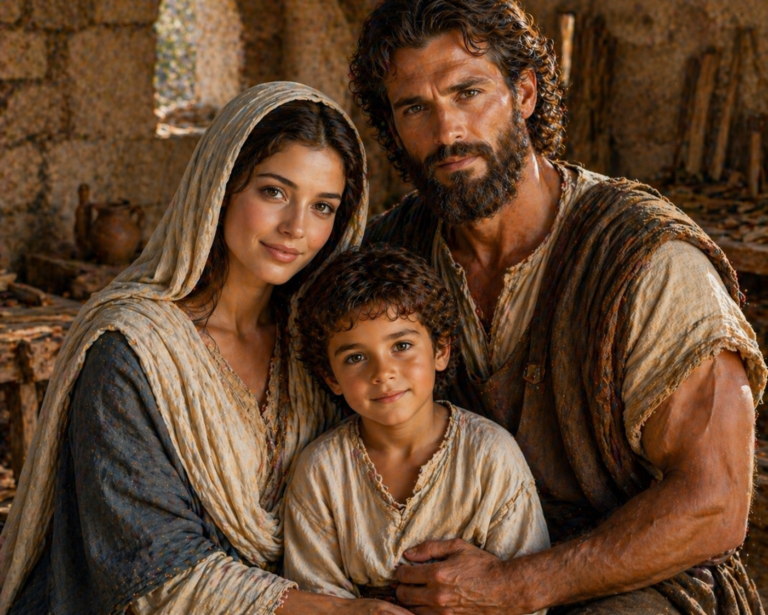
The Feast of the Holy Family is a profound celebration within the Christmas season that invites a deeper contemplation of the hidden life of Jesus, Mary, and Joseph. While Christmas proclaims the mystery of the Incarnation—the Word made flesh—this feast turns the focus toward what came after: the quiet, sustained life of God within a human family. It is here, in the ordinary rhythms of home, that divine love is lived out daily, patiently, and faithfully. Celebrated on the Sunday after Christmas (or December 30 when Christmas falls on a Sunday), the feast emphasizes that the family is not merely a social structure, but a sacred environment where human persons are formed, strengthened, and oriented toward God. The Holy Family is presented not as an unreachable ideal, but as a model that reveals how holiness can be pursued within the realities of everyday life.
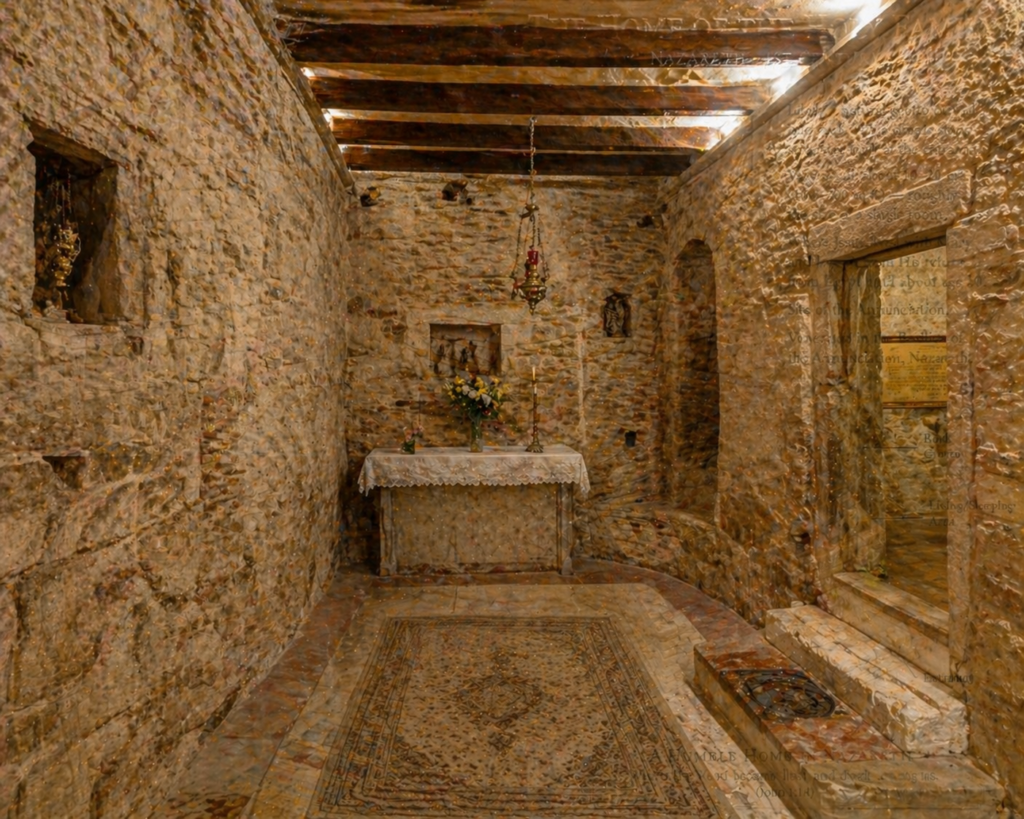
The home of the Holy Family in Nazareth was simple, humble, and hidden from the eyes of the world. There were no signs of worldly grandeur—no wealth, no prestige—yet within that home dwelt the fullness of divine life. This reality alone elevates the meaning of family life: that God chose to enter the world not only through a mother, but within a family. Mary’s role is one of profound receptivity and unwavering faith. Her “yes” to God did not end at the Annunciation; it extended into every moment of her life—raising Jesus, pondering the mysteries surrounding Him, and remaining faithful even when understanding was incomplete. The home of the Holy Family in Nazareth was simple, humble, and hidden from the eyes of the world. There were no signs of worldly grandeur—no wealth, no prestige—yet within that home dwelt the fullness of divine life. This reality alone elevates the meaning of family life: that God chose to enter the world not only through a mother, but within a family. Mary’s role is one of profound receptivity and unwavering faith. Her “yes” to God did not end at the Annunciation; it extended into every moment of her life—raising Jesus, pondering the mysteries surrounding Him, and remaining faithful even when understanding was incomplete.

Christ was Entrusted to a Father Who was not His by Nature

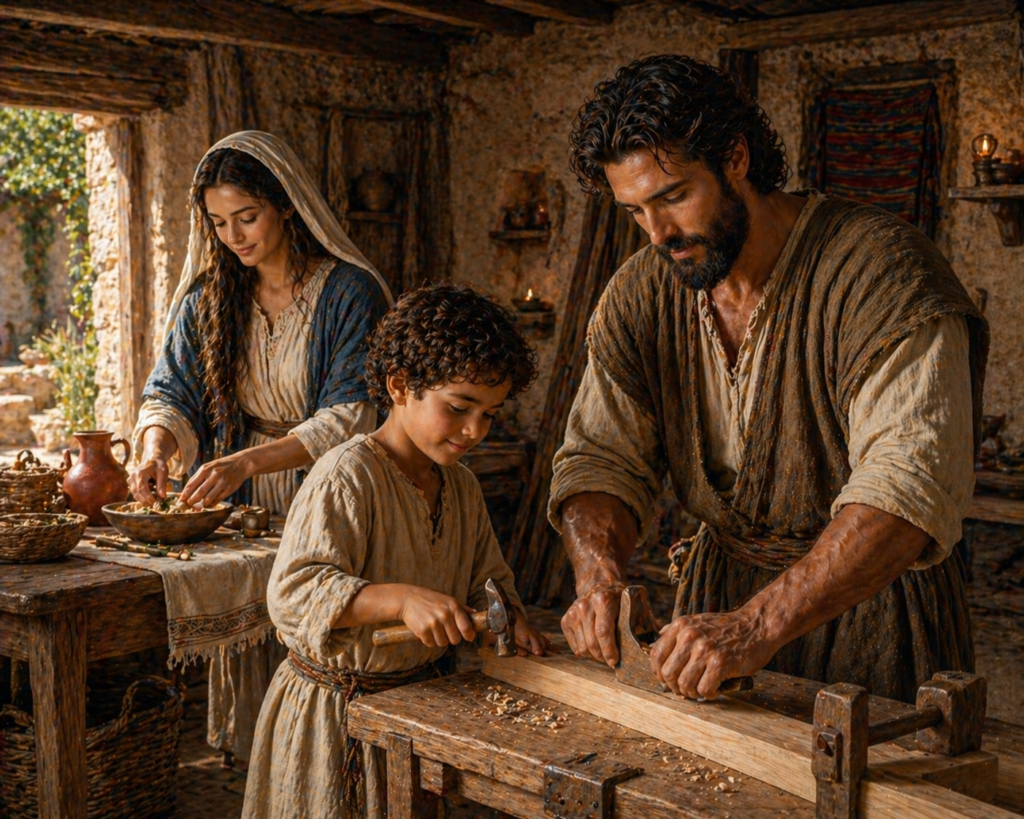
The Gospels give very little detail about Jesus’ early years, yet this silence is meaningful. It reveals that the majority of Christ’s earthly life was spent not in public ministry, but in the hiddenness of family life. He grew, learned, worked, and lived within the structure of a household. In doing so, Jesus sanctified the ordinary. Work, obedience, family relationships, and daily routines are no longer merely human necessities—they are pathways to holiness. The hidden years in Nazareth affirm that greatness in the eyes of God is often found in what the world overlooks.
At the heart of this feast is not only the quiet strength of Joseph, but the deeper reality that the Holy Family itself reveals a form of fatherhood—and family life—that transcends mere biology. Joseph was not the biological father of Jesus Christ, yet he embraced a true and complete fatherhood, raising Him entirely as his own in what can rightly be understood as a profound form of foster fatherhood or even formal adoption in its fullest sense. This reveals a powerful theological truth: that authentic fatherhood is not defined solely by physical generation, but by faithful presence, responsibility, sacrifice, and love. Joseph chose this role through radical trust in God, accepting a mystery beyond human comprehension and responding with obedience rather than hesitation. By taking Mary into his home and dedicating his life to the care of both her and the Child, he became the earthly guardian of the Son of God, providing, protecting, and forming Him in His human life—teaching Him a trade, guiding Him in daily discipline, and embodying integrity through action rather than words. In this way, the Holy Family becomes not only a model of domestic holiness, but also a living image of divine adoption: just as Christ was entrusted to a father who was not His by nature but fully His by love, so too are we called to become adopted children of God—not by birth, but by grace.

Feast of the Holy Family Traditions to Make Your Own

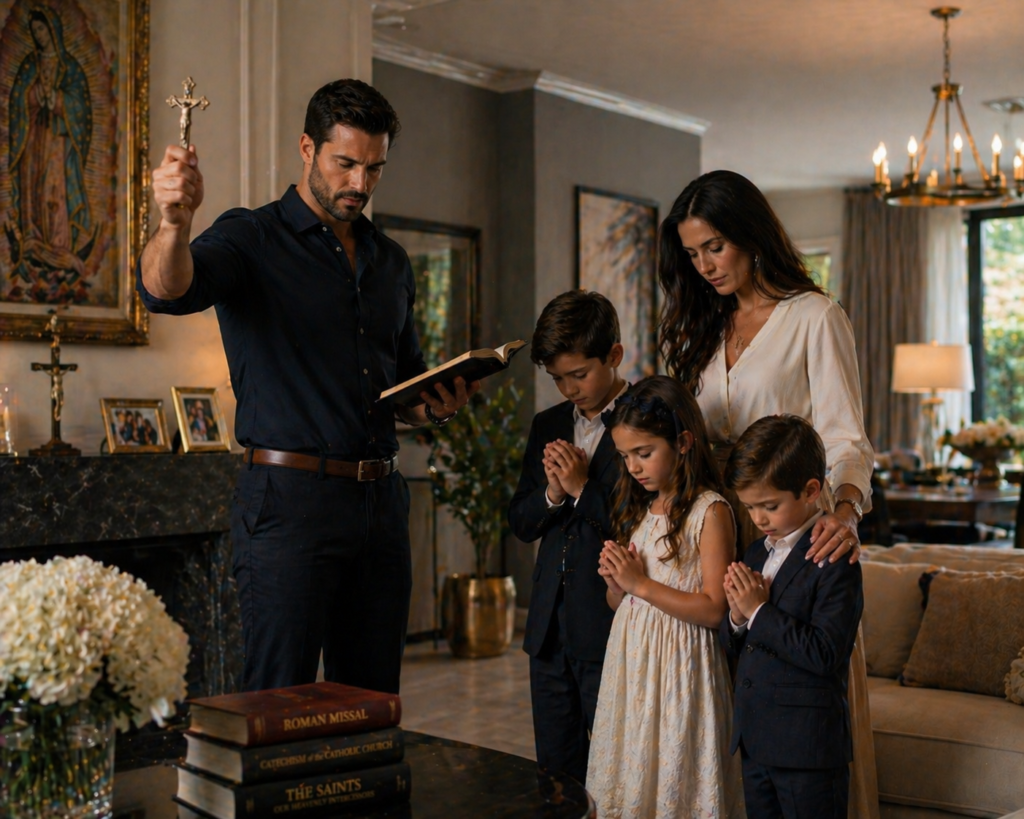
Family Blessing of the Home
One of the most beautiful traditions is a formal blessing of the household. Families gather together—often near a Nativity scene—and pray for unity, protection, and love within the home. Some will even go room to room, asking God to dwell in every part of the house. This reflects the deeper truth of the feast: that the home itself is meant to become a sacred place, just like Nazareth.

Renewal of Family Commitments
This feast is often used as a moment to renew family bonds. Parents may bless their children. Children may thank and honor their parents. Families may speak intentions for the coming year. It’s a powerful time to restore what may have become routine—turning relationships back into something intentional and meaningful.

Lighting Candles Together
Lighting candles as a family symbolizes Christ as the light within the home. Some families light one central candle (Christ), then smaller candles for each family member. This creates a visual reminder that each person contributes to the unity of the whole.

Reading Scripture as a Family
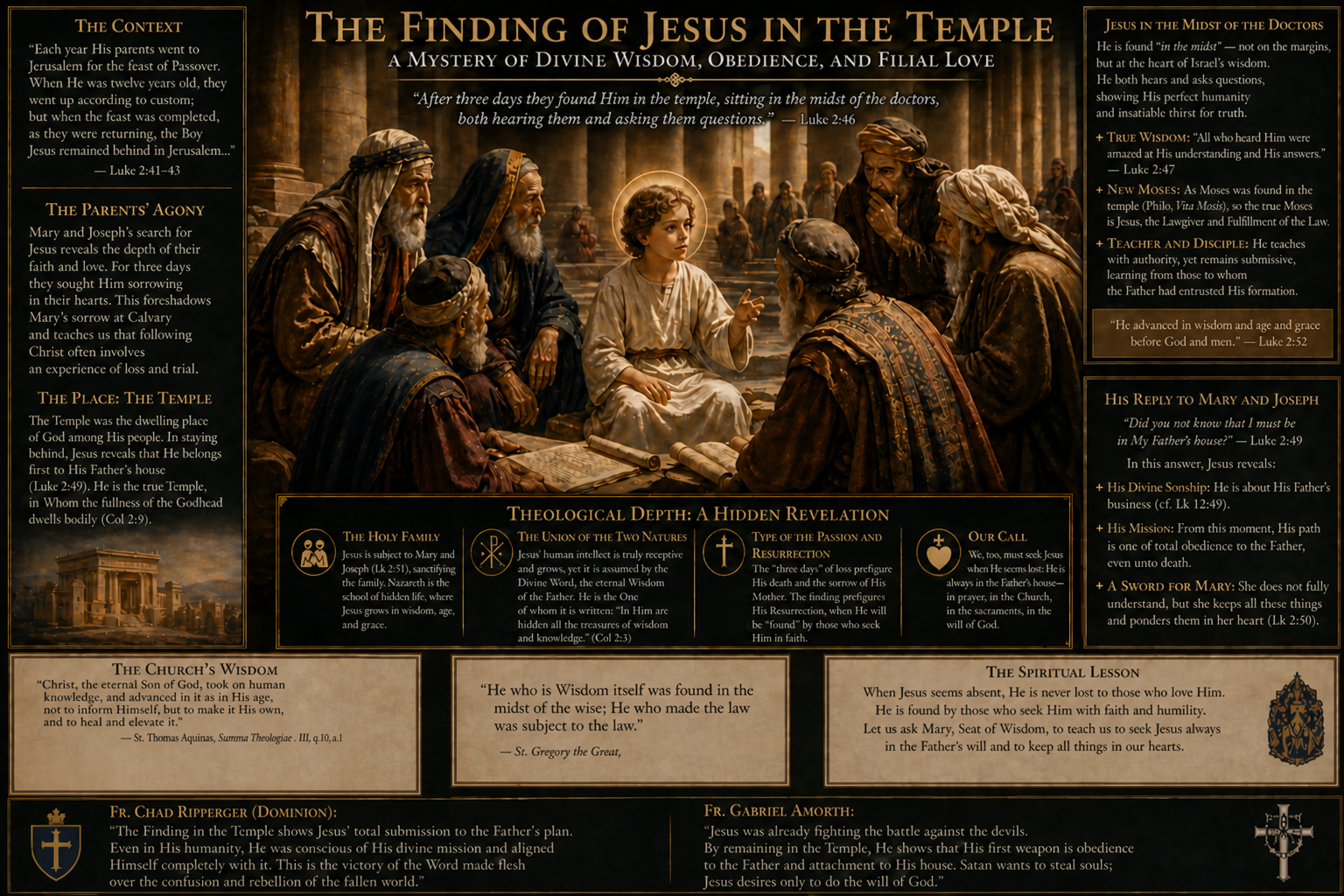
Many families read passages such as: The finding of Jesus in the temple (Luke 2:41–52), The Nativity accounts, and reflections on family life in Scripture. This reinforces the idea that faith is meant to be lived together, not just individually.

Sharing a Special Family Meal
A meal is central to this feast—simple or elegant, but intentional. The focus is not extravagance, but eating together, being present, and expressing gratitude. Some families prepare dishes that are traditional to their culture and symbolic of unity or nourishment. It becomes a reflection of the Holy Family’s shared life.

Honoring Fathers—Especially Foster & Spiritual Fatherhood
Because of Joseph’s role as the foster father of Jesus, this feast is a meaningful time to recognize fathers in a deeper way. This can include: Honoring adoptive fathers, stepfathers, and mentors, Reflecting on the strength of chosen responsibility, and Acknowledging that true fatherhood is lived through love and sacrifice. Joseph’s example gives this day a powerful dimension that goes beyond biology.

Attending Mass Together
For many, the most important tradition is attending Mass as a family unit. This reinforces unity in faith, shared spiritual direction, and the idea that the family is part of something greater.

Forgiveness & Reconciliation
This feast is a natural moment to let go of tension, offer forgiveness, restore peace in relationships. It’s a reset point—especially meaningful so soon after Christmas.

Creating or Renewing a “Family Rule of Life”
Some families take time to establish guiding principles such as prioritizing time together, daily prayer habits, and respect and communication standards. This mirrors the ordered, intentional life of the Holy Family.

 The Deeper Meaning Behind the Traditions
All of these traditions point to one central truth: The Feast of the Holy Family is not just about honoring one family in history— it is about transforming your own family into something sacred. It’s a day to recognize that Love can be chosen daily, Fatherhood (like Joseph’s) can be lived with strength and humility, and the home can become a place where God truly dwells. 
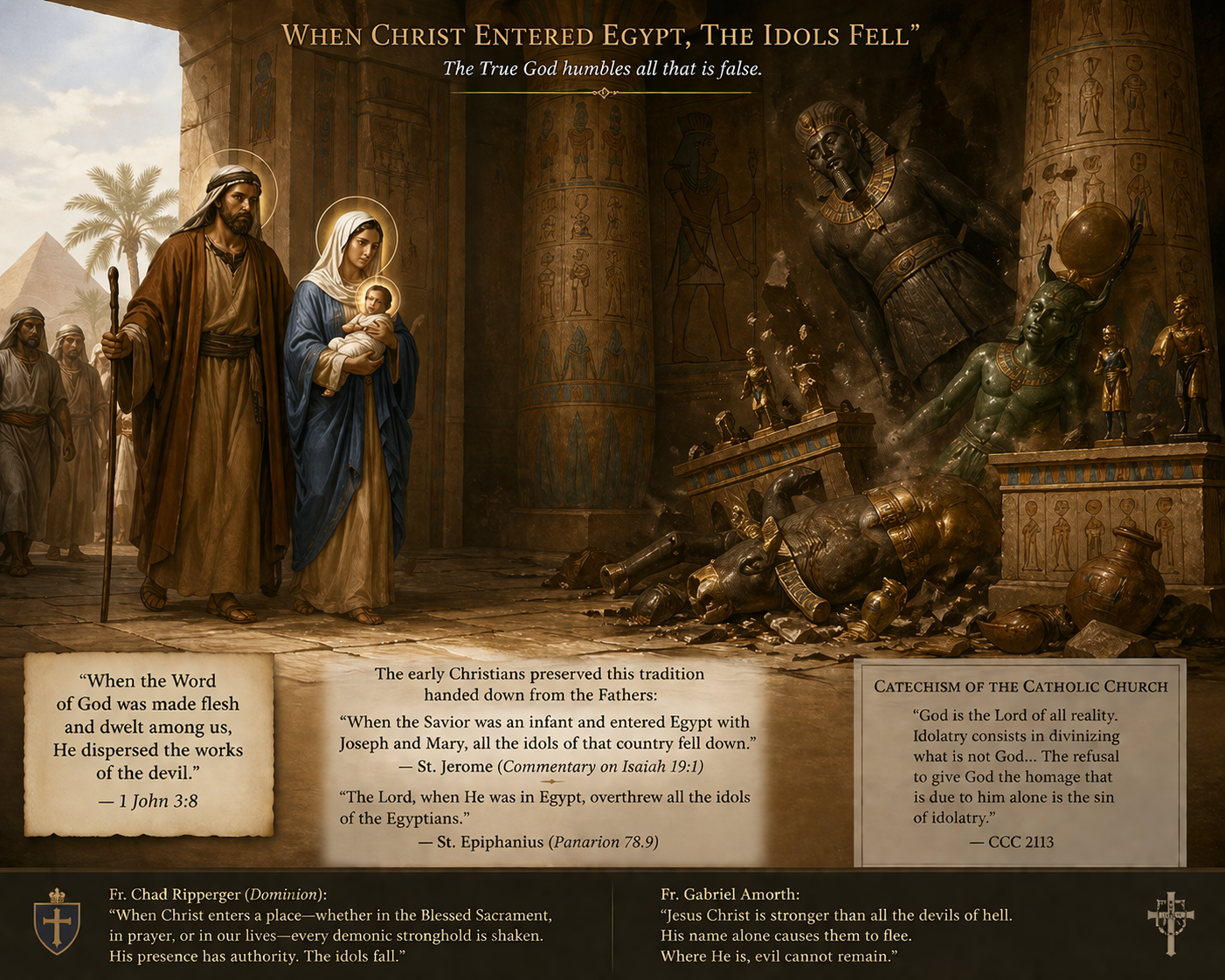
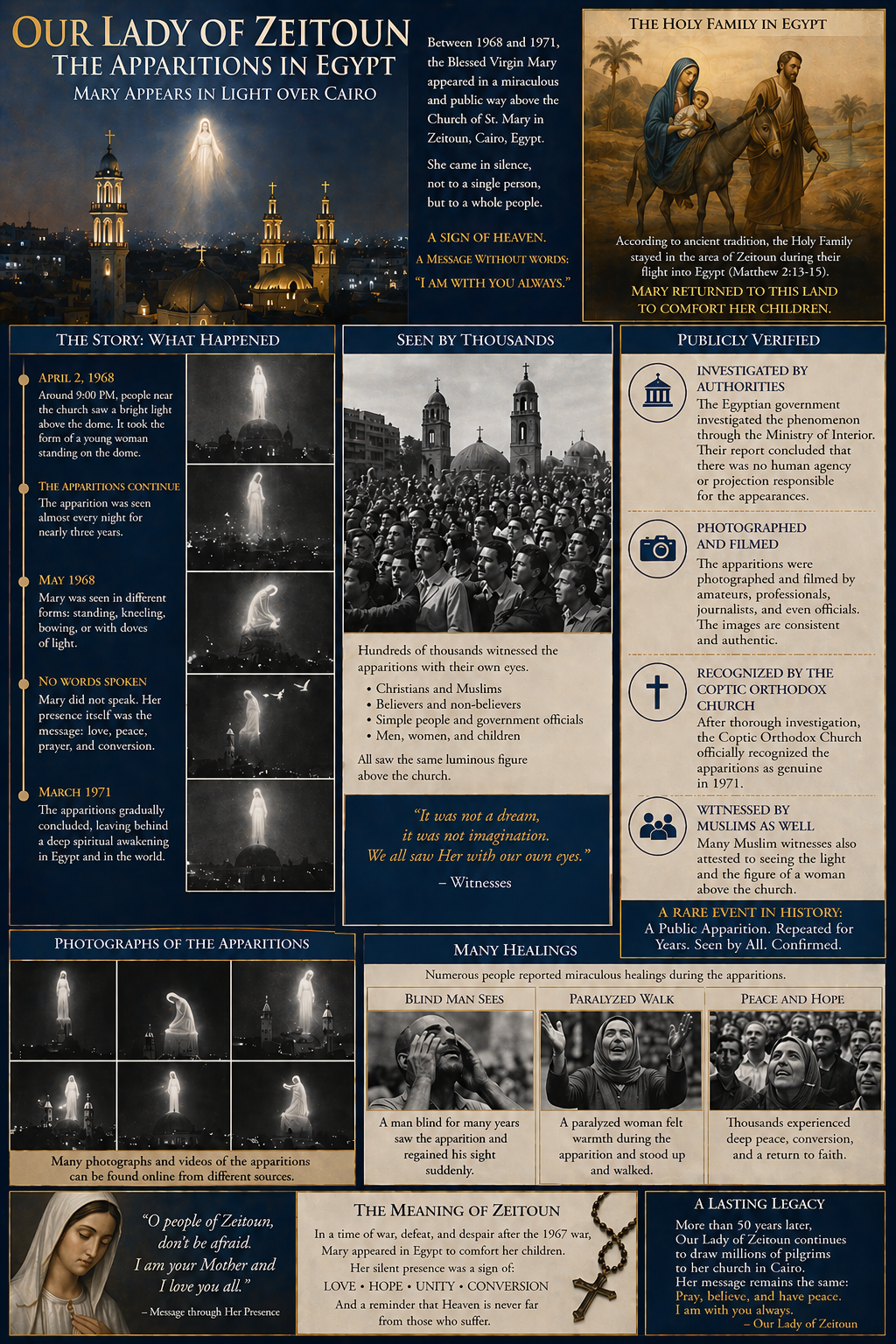
Drawing from Scripture, historical context, and the more cautious use of private revelations, the life of the Holy Family—Jesus Christ, Mary, and St. Joseph—was marked by real hardship, though some details must be carefully qualified. Their flight into Egypt made them true refugees, living in a foreign land where Joseph likely faced unstable or underpaid work, and where they would have experienced the strain of being outsiders without social support. Tradition generally holds that they remained there for a few years (often around 2–4), though mystics such as Blessed Anne Catherine Emmerich and Venerable Mary of Agreda describe a longer and more difficult stay; holding that Christ was as old as around seven or eight years old at their return (this is not a universally attested conclusion, but rather an interpretation drawn mainly from certain readings of Emmerich’s visions). The notion that the Holy Family (especially Mary) endured suspicion or whispered slander is supported indirectly by Scripture—such as the remark in the Gospel of John (John 8:41)—as well as by early hostile sources and the cultural reality of a small, honor-based society where the mystery of Christ’s conception would not have been widely understood. Mystical writings deepen this picture by portraying Mary as silently bearing misunderstanding, but they do not stand as the primary source. Taking all facts into consideration, the realistic picture reveals that the Holy Family lived a hidden life marked by poverty, displacement, labor, and likely misunderstanding, sanctifying these ordinary yet profound sufferings.
The traditions surrounding the Feast of the Holy Family are rooted in a single, unifying purpose: to transform the home into a place of intentional love, unity, and spiritual strength. Unlike many celebrations that emphasize external expression, these traditions are deeply interior—they focus on relationships, presence, and the quiet formation of virtue within the family itself. At their core, these practices mirror the hidden life of Jesus, Mary, and Joseph in Nazareth. Their home was not marked by spectacle, but by faithfulness in ordinary moments. In the same way, the traditions of this feast elevate the everyday—conversation, shared meals, prayer, and mutual care—into something meaningful and sacred. The blessing of the home reflects a desire to invite God into the very structure of family life. It acknowledges that a house becomes more than a physical space when it is ordered toward goodness, peace, and purpose. Lighting candles and gathering in prayer reinforce this idea visually and spiritually, symbolizing Christ as the center from whom all unity flows. The renewal of family commitments and the practice of forgiveness highlight an essential truth: strong families are not those without conflict, but those willing to restore and strengthen their bonds. These traditions create space for humility, gratitude, and reconciliation—qualities that sustain relationships over time. Sharing a meal together serves as a tangible expression of unity. It is a moment where distractions are set aside and presence is prioritized. In this simple act, the family reflects the harmony and togetherness of the Holy Family, where daily life itself became an offering. A particularly meaningful dimension of these traditions is the recognition of fatherhood through the example of Joseph as foster father. His life gives depth to the celebration, reminding us that true fatherhood is defined not merely by biology, but by commitment, protection, and sacrificial love. Honoring fathers—especially adoptive, step, or spiritual fathers—acknowledges the dignity of those who choose to lead and care for others with integrity. Ultimately, these traditions are not meant to be performed mechanically, but lived intentionally. They are an invitation to slow down, to be present, and to cultivate a home environment where each member is valued and strengthened. Through them, the family becomes more than a unit of living—it becomes a place of formation, where love is practiced daily and where the presence of God is quietly, but powerfully, made known.
The long, silent years of Jesus Christ in Nazareth—lived in the company of Mary and St. Joseph—are often overlooked, as though nothing of consequence occurred. Yet in truth, this hidden life is not an absence of action, but a revelation of divine strategy. God chose not constant public glory, but obscurity, simplicity, and obedience. This choice is not accidental. It reveals something fundamental about the spiritual life: humility is not weakness, but power—precisely because it stands in direct opposition to pride.
At the root of all spiritual conflict lies a deeper, interior battle. As the saints consistently teach, the true struggle is not first external but within the human heart. Pride declares, “I will exalt myself,” while humility responds, “I receive everything from God.” This is why humility possesses such strength. Augustine of Hippo expressed this with striking clarity: “It was pride that changed angels into devils; it is humility that makes men as angels.” In this light, humility is not merely a virtue among others—it is the foundation of restoration.
The hidden life of Christ itself becomes the model. For nearly thirty years, the Son of God lived in obscurity, engaged in manual labor, and subject in obedience. This was not wasted time, nor merely preparation—it was redemption already unfolding. Thérèse of Lisieux grasped this mystery deeply when she wrote, “Jesus does not demand great actions from us, but simply surrender and gratitude.” The lesson of Nazareth is clear: greatness is not found in visibility, but in union with God within the ordinary.
No one embodies this hidden humility more perfectly than Mary. Though she is truly the Mother of God and Queen of Heaven, her earthly life was marked by silence, obscurity, and total surrender. Louis de Montfort reflects on this paradox: “Mary is the most hidden and unknown of all creatures.” Yet it is precisely through this hiddenness that she becomes the most powerful of intercessors. Her greatness is not diminished by her humility—it is revealed through it.
The saints consistently affirm that humility is not passive, but stabilizing and transformative. St. Benedict teaches, “The first degree of humility is prompt obedience,” showing that humility orders the soul and gives it strength. Teresa of Ávila adds, “Humility is truth,” not self-deprecation, but the clear recognition that God is everything and we are wholly dependent on Him. Likewise, Alphonsus Liguori writes, “He who trusts in himself is lost. He who trusts in God can do all things,” emphasizing that humility opens the soul to grace—the true source of power. And Francis de Sales simply states, “Humility perfects us in the presence of God.”
This is why humility is so feared by evil. Pride is the root of all rebellion, including the fall of the angels. To embrace humility—obedience, submission to God, and self-forgetfulness—is to directly oppose that rebellion. Spiritual writers, including Chad Ripperger, emphasize that such dispositions are intolerable to demonic forces because they undermine the very foundation of pride upon which evil stands.
Seen in this light, the hidden life of Nazareth is not passive at all—it is a quiet but decisive form of spiritual warfare. Every act of obedience weakens pride. Every hidden sacrifice builds grace. Every unnoticed act done for God carries eternal weight. What appears small in the eyes of the world becomes immense in the order of grace.
This is the essence of what Thérèse of Lisieux called the “Little Way”: “Do small things with great love.” Far from being a lesser path, it is the very path chosen by Christ Himself for the greater part of His earthly life.
In the end, the Gospel overturns the expectations of the world. The world seeks visibility, recognition, and power. But divine revelation teaches something entirely different: the most powerful life may appear the smallest. Pride isolates and fragments, but humility unites the soul to God. And it is precisely this union with God that is the source of all true strength.

A Place of Peace in Trial, Of Faith in Uncertainty

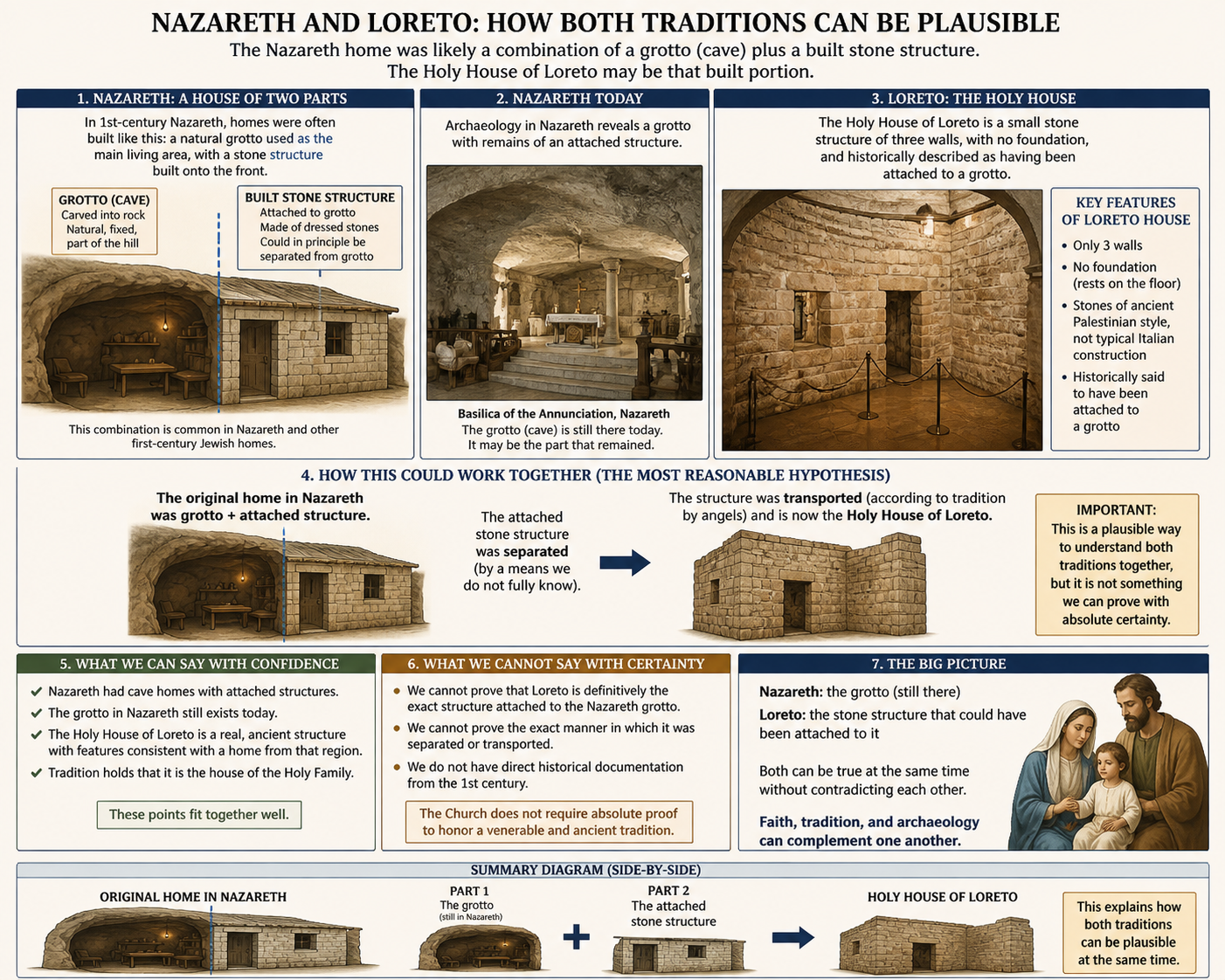
The Holy House of Loreto is traditionally believed to be the very dwelling of the Holy Family in Nazareth, miraculously preserved and now enshrined within the Basilica of the Holy House. According to longstanding and approved tradition, this small stone structure—measuring roughly 9 by 4 meters (about 30 by 13 feet)—is the same humble home in which Mary received the Annunciation and where Jesus Christ lived His hidden life with Joseph. Unlike typical buildings, the Holy House notably lacks a proper foundation, consistent with being originally set against a grotto in Nazareth, and its stones match those found in the Holy Land rather than Italy. While the manner of its arrival—traditionally attributed to angelic transport, though also possibly involving a noble family named “Angeli”—is not defined as dogma, the Church permits and supports devotion to the site, which has been venerated for centuries by pilgrims and saints. Theologically, the House of Loreto stands as a powerful continuation of Nazareth’s hidden mystery: a poor, simple dwelling that once contained the Incarnation itself, now preserved as a tangible reminder that God chose to enter the world not through grandeur, but through humility, silence, and the ordinary life of a home made holy by His presence. Based on the traditional dimensions of the Holy House in Loreto—approximately 30 by 13 feet (about 390 square feet total)—this would mean that Jesus Christ, Mary, and Joseph each had roughly 130 square feet of space per person, still simple and modest, though somewhat more spacious than the smaller Nazareth estimate.
Heavenly Father,
You chose to reveal Your love through the home of Nazareth,
where Jesus, Mary, and Joseph lived in unity, obedience, and peace. We place our family before You today.
Enter our home and dwell within it.
Strengthen every bond, heal every wound,
and root us firmly in truth, patience, and love. Lord Jesus,
who lived in humility within the care of Mary and Joseph,
teach us to honor one another,
to serve without pride,
and to grow in wisdom through the life we share. Bless all mothers,
that they may reflect the faith and devotion of Mary—
steadfast, gentle, and strong in trust. Bless all fathers,
especially those who, like Joseph,
have chosen the path of responsibility and sacrifice.
Grant them courage, integrity, and quiet strength.
May they lead not by force, but by example—
protecting, providing, and loving with unwavering devotion. Bless those who serve as fathers not by birth, but by calling—
adoptive fathers, stepfathers, and mentors—
that their role may be honored and their impact made fruitful. Holy Family of Nazareth,
make our home like yours:
a place of peace in trial,
of faith in uncertainty,
and of love in all things. Teach us to forgive quickly,
to speak with kindness,
and to remain united even in difficulty. May our home become a place where You are known,
where You are welcomed,
and where You are lived each day. We entrust our family to Your care,
now and always.
Amen.
The most historically grounded understanding is that the Holy Family—Jesus Christ, Mary, and St. Joseph—had a single, stable home base in Nazareth both before the Flight into Egypt and after their return, in keeping with the Gospel account (Matthew 2:23) and the normal patterns of first-century life, where families did not typically abandon one dwelling to establish another nearby without necessity; archaeology at the site beneath the Basilica of the Annunciation confirms that such homes commonly consisted of a natural grotto carved into rock with a modest stone structure built onto its entrance, forming a unified dwelling, and this model provides one of the most plausible ways to reconcile the Nazareth site with the long-venerated tradition of the Holy House of Loreto, which is a small three-walled stone structure without foundation that appears architecturally consistent with having once been attached to such a grotto; in this view, the Nazareth grotto—still preserved and venerated—would represent the immovable portion of the home, while the Loreto structure could correspond to the built exterior portion, though this cannot be proven with modern certainty and remains a matter of tradition rather than dogma; according to that tradition, widely held for centuries and supported devotionally by many saints, the house was miraculously transported from Nazareth in the late 13th century, with early accounts describing witnesses along the Adriatic coast and in Dalmatia reporting a small stone house appearing suddenly without foundations, sometimes accompanied by luminous phenomena or angelic presence, and later testimony in Loreto itself recounting that the structure was seen to arrive borne through the air, with chroniclers speaking of “angels carrying the house” and villagers astonished to find it resting intact in a new location overnight, while other historical interpretations suggest the involvement of the noble Angeli family in transporting materials; the Church does not definitively pronounce on the mechanism, but permits and encourages devotion to the Holy House as intimately connected with the mystery of the Incarnation, and thus, while we cannot assert with absolute certainty that the Loreto structure is physically identical to the Nazareth dwelling, the most coherent synthesis is that there was one Nazareth home—grotto and attached structure together—which served as the enduring center of the Holy Family’s hidden life, temporarily left during their exile in Egypt (where they likely lived in simple, undocumented conditions as refugees) and then reoccupied upon their return, and that the Loreto house, whether by miraculous translation or human agency, is best understood not as a second, separate home, but as a continuation—physical or devotional—of that same humble dwelling in which the Word was made flesh.

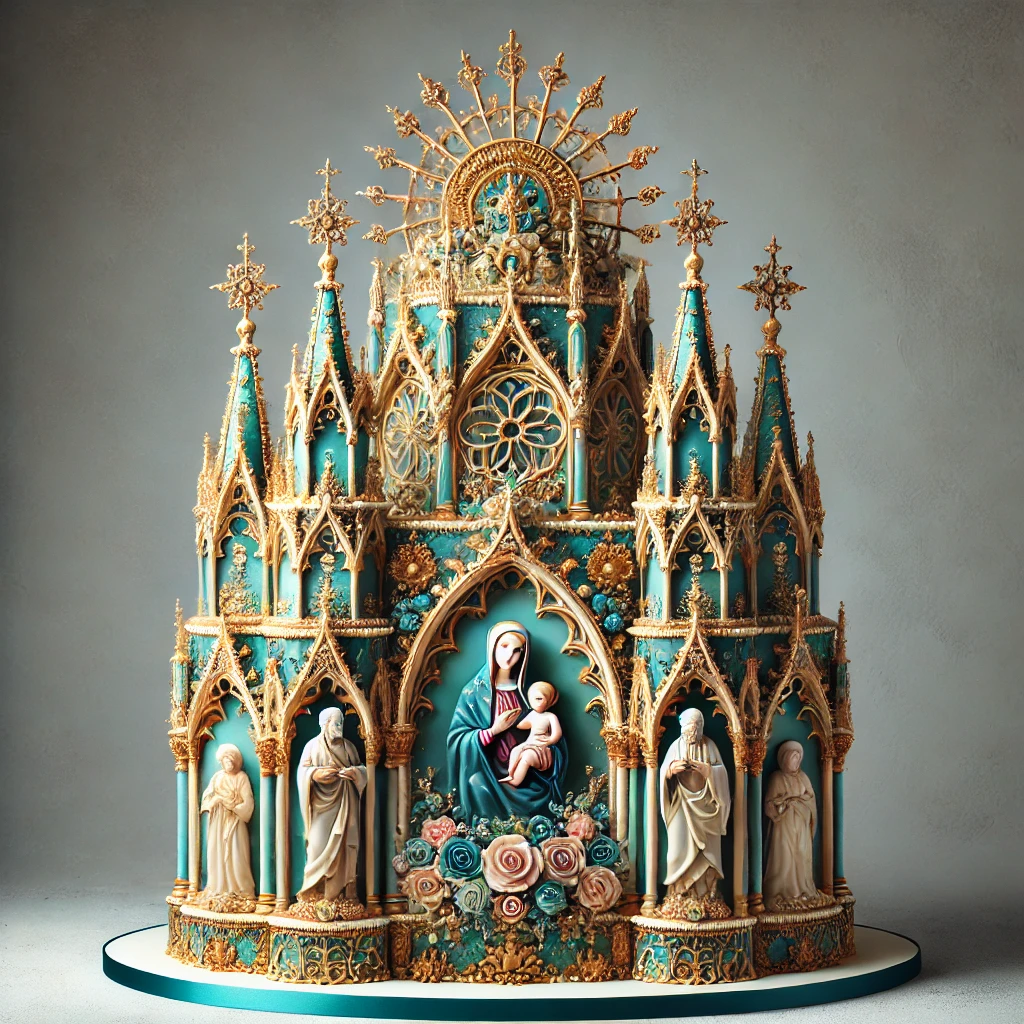
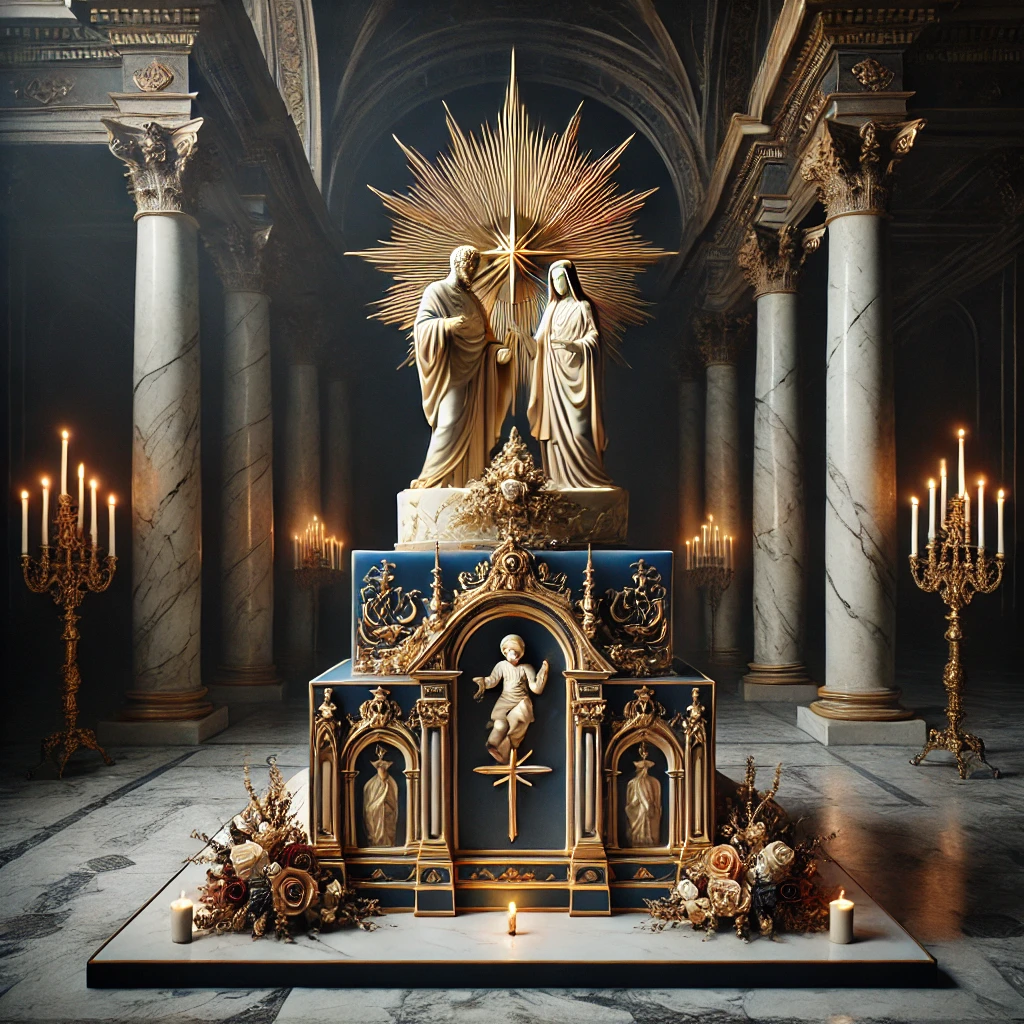
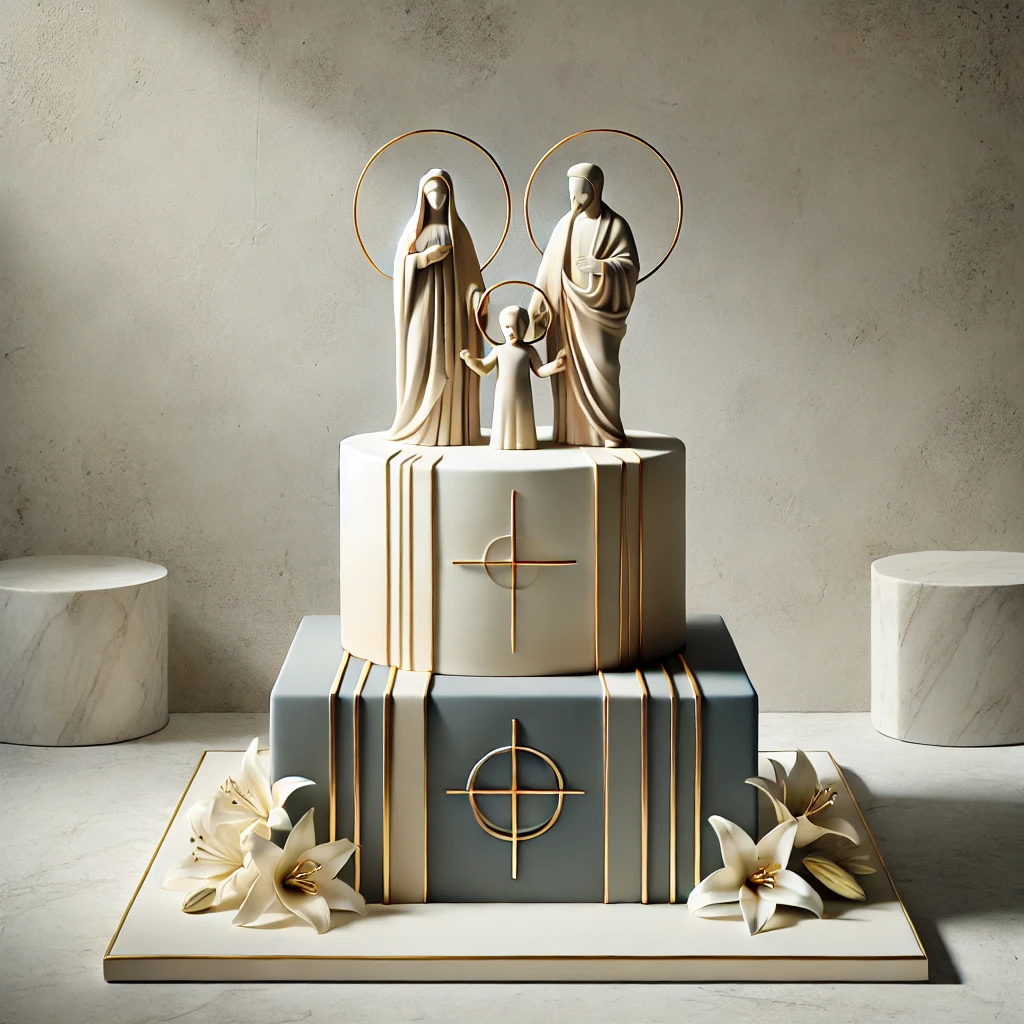
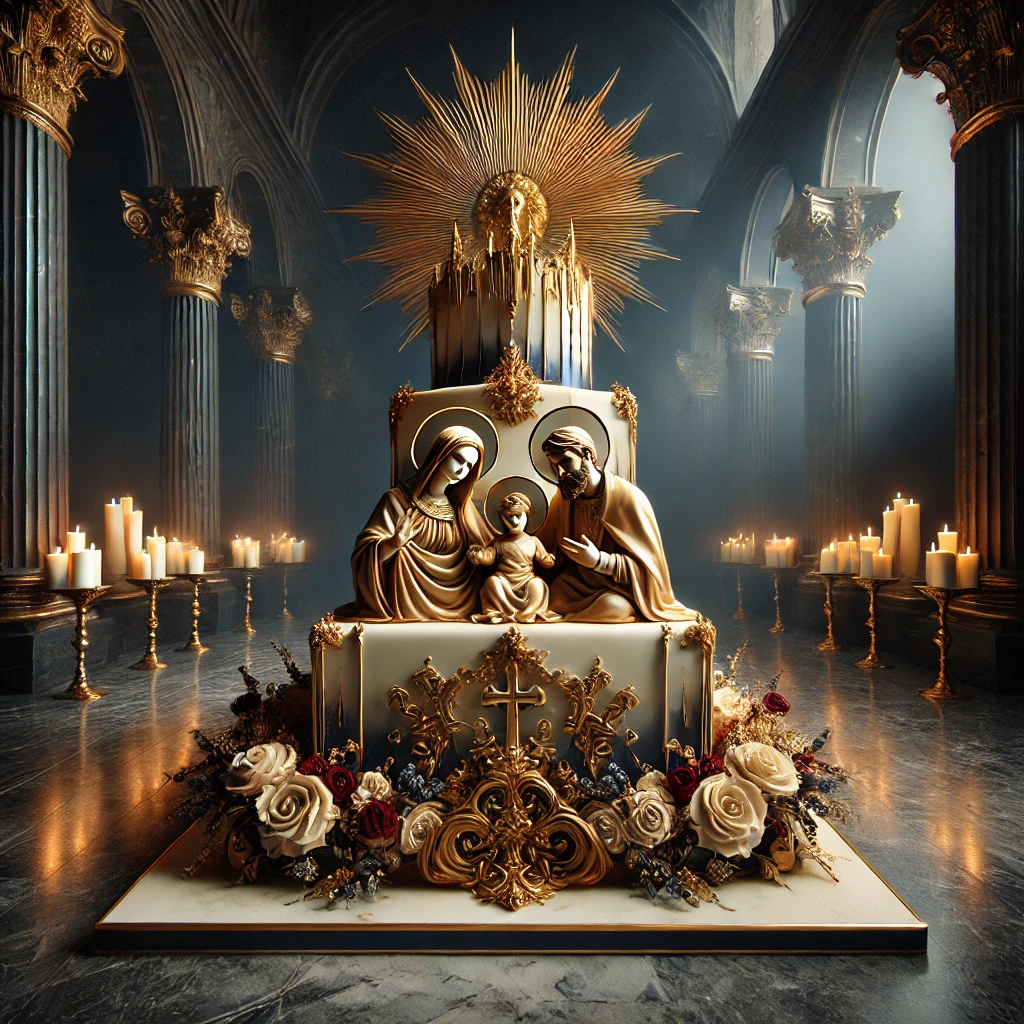
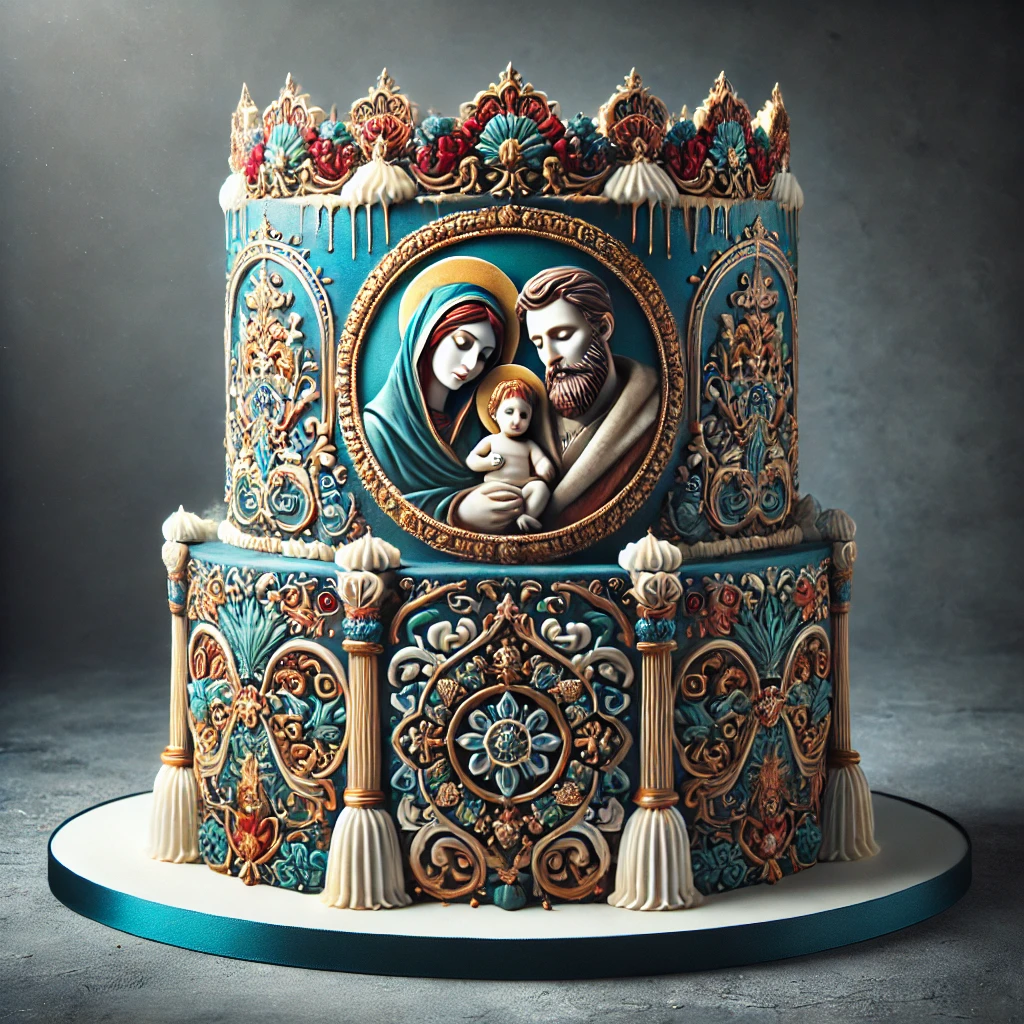
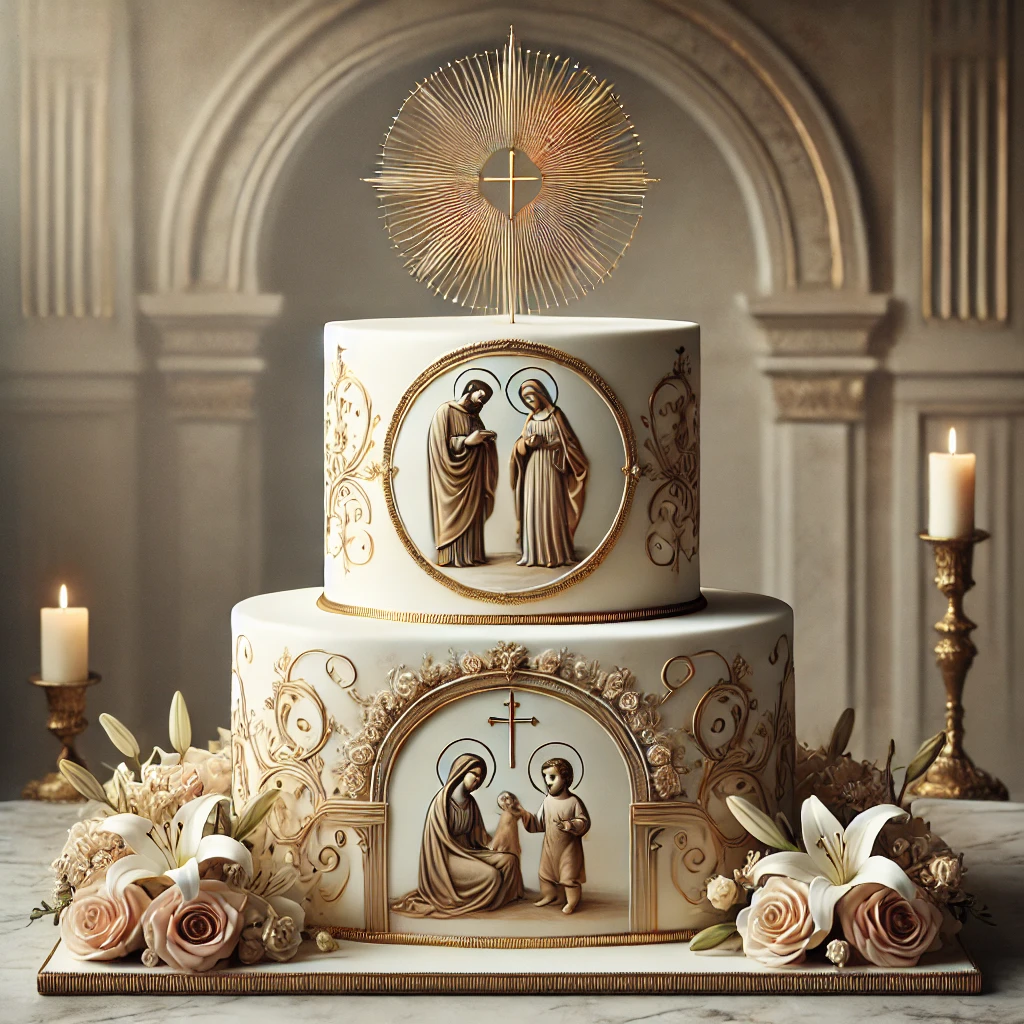
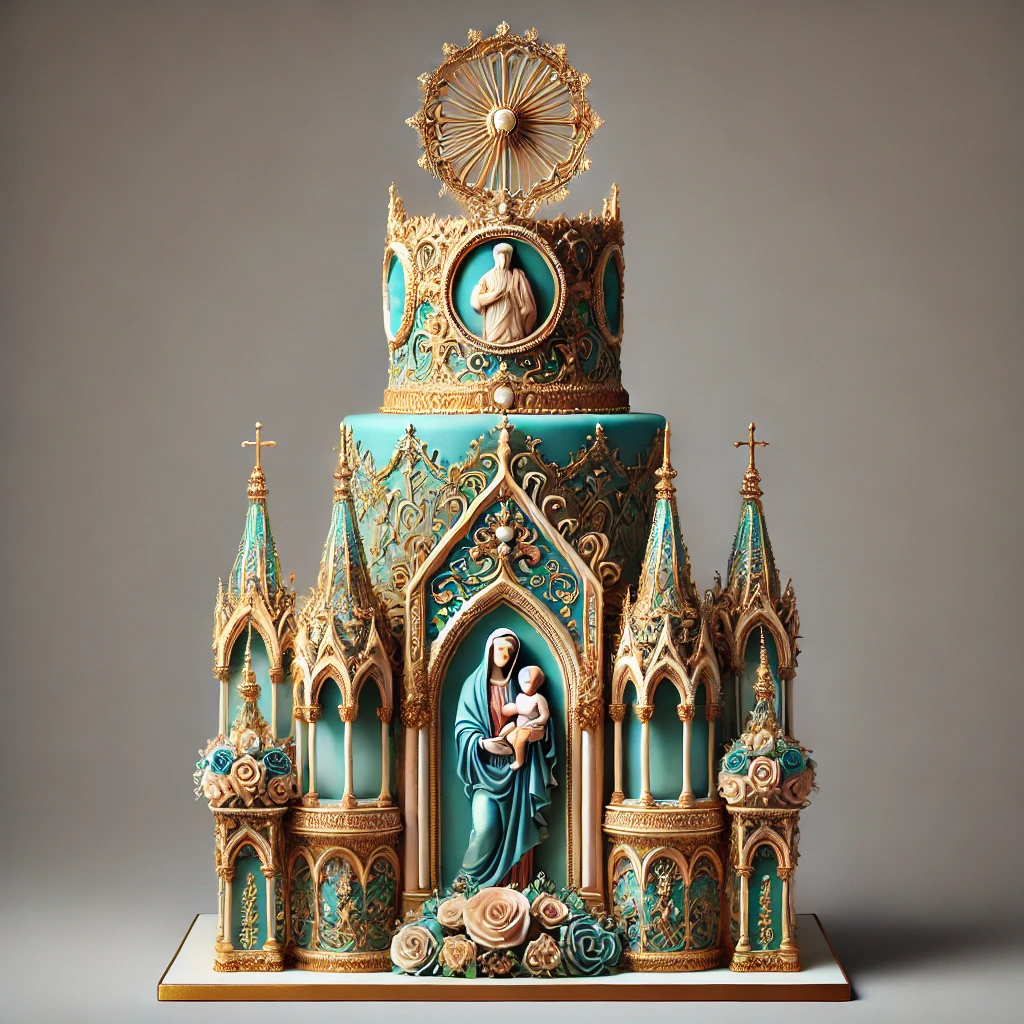
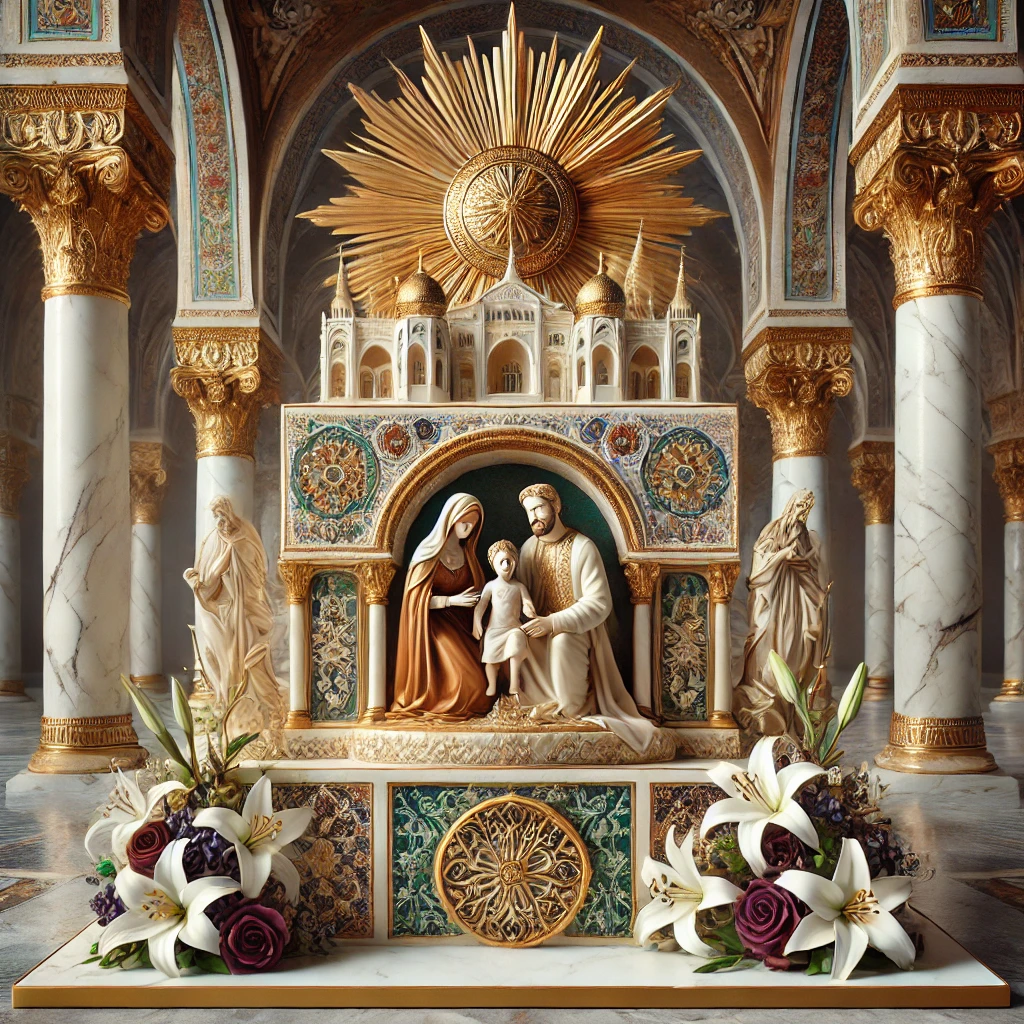
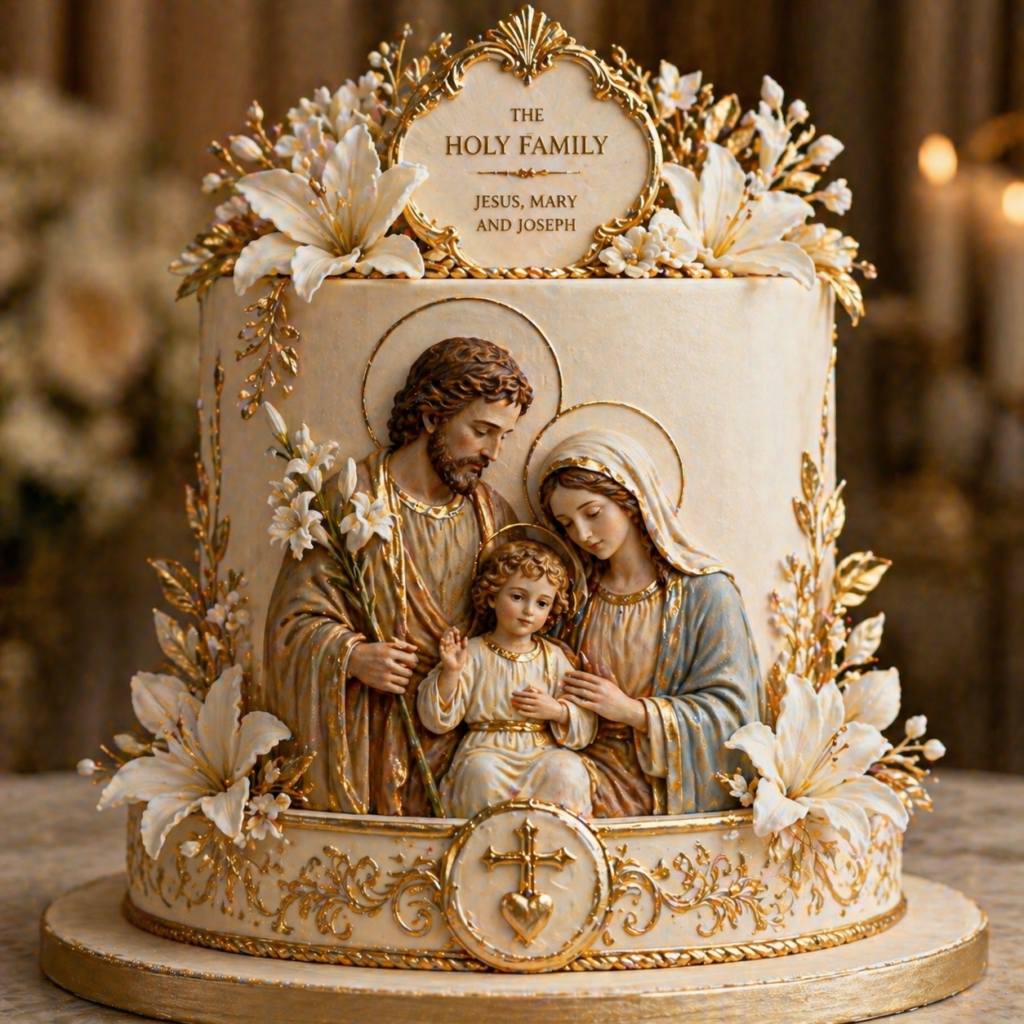
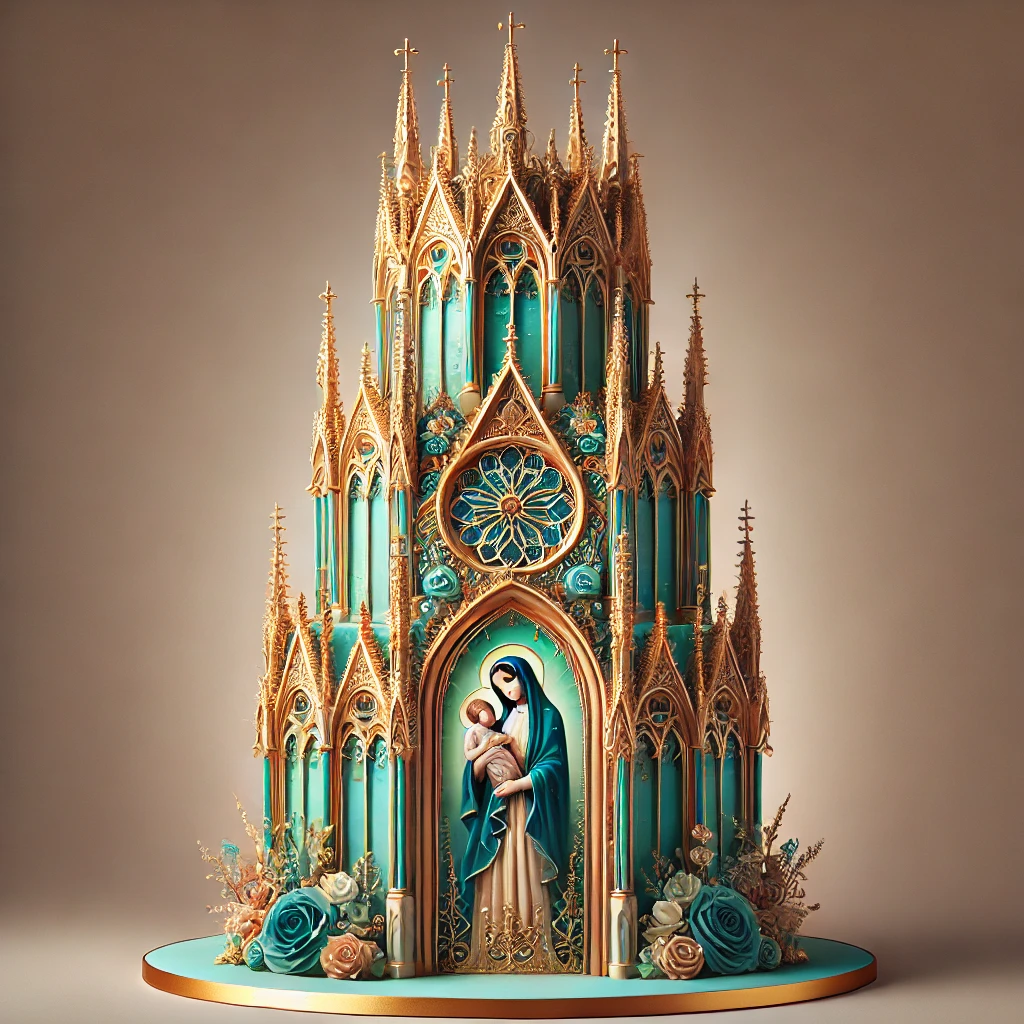
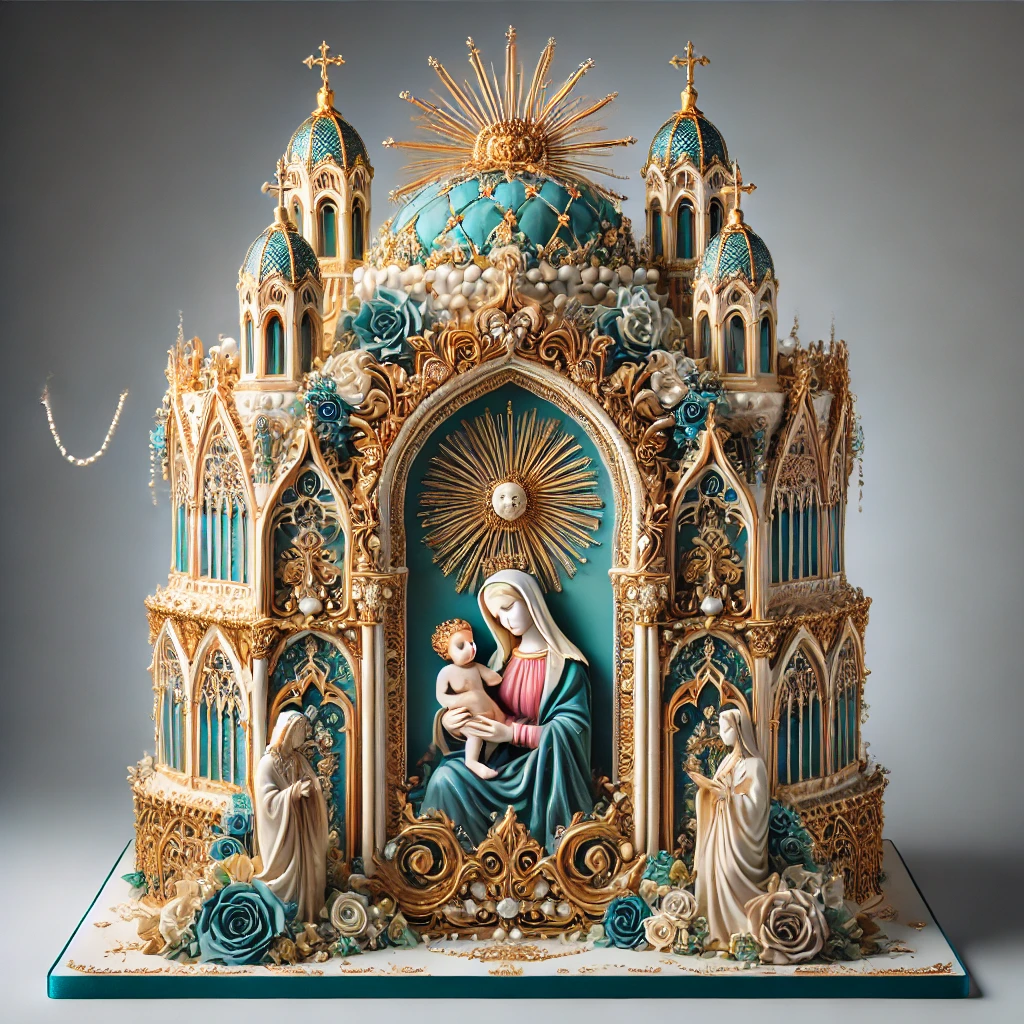
Feast of the Holy Family Cake and Atmosphere Ideas

Where style, memory, and celebration meet.

This section is meant to be more than Cake Decorating Ideas… it’s designed to spark inspiration and creativity, awaken tradition, and infuse your special occasions with style, identity, and atmosphere. A color palette becomes a theme. A design becomes a mood. Simple details—like sugared holly leaves or shimmering stars—can set the tone for a gathering and become part of cherished traditions and lasting memories melded with personal touch and love.

Traditional Feast of the Holy Family Dishes

• Herb-Roasted Chicken
A classic symbol of nourishment and provision—simple, whole, and shared. Roasted with garlic, rosemary, and butter or olive oil, it reflects the humble strength of family life.
• Slow-Roasted Lamb
A richer, more ceremonial option. Lamb carries deep biblical symbolism and brings a sense of reverence and significance to the table.
• Braised Beef (Short Ribs or Roast)
Slow-cooked and tender, this dish represents patience, endurance, and care—qualities lived out daily within the family.
• Whole Baked Fish with Lemon & Herbs
A lighter, traditional option tied to early Christian symbolism, representing faith and spiritual nourishment.
• Fresh Bread (Sourdough or Rustic Loaf)
Bread is essential—it represents daily provision and shared life. Breaking bread together reinforces unity.
• Garlic Mashed Potatoes
Comforting and grounding, symbolizing the stability of the home.
• Roasted Root Vegetables
Carrots, parsnips, and potatoes roasted with herbs—representing being rooted, steady, and nourished.
• Herb Rice or Simple Grain Dish
A clean, balanced addition that keeps the meal intentional, not overwhelming.
• Simple Green Salad with Olive Oil & Vinegar
Light, pure, and refreshing—representing clarity and renewal.
• Citrus & Herb Salad
Bright and vibrant, symbolizing life, joy, and new beginnings within the family.

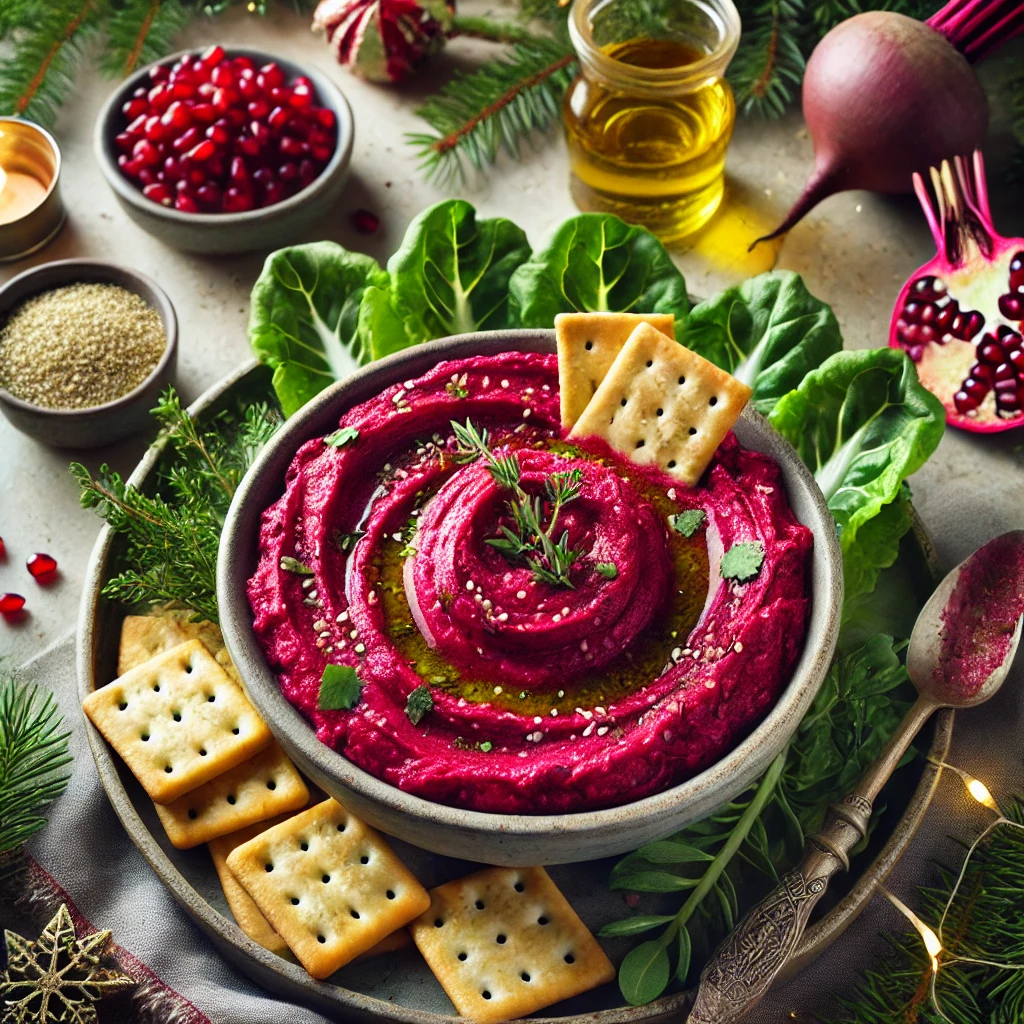
Winter Recipes