




































Saint Thérèse of Lisieux
with ORO VALENTIO
October 1st
There are souls who conquer the world through greatness, and there are souls who quietly transform it through love. Among the latter stands Thérèse, a young woman hidden within the silence of a cloister, whose life unfolded not through grand public achievements, but through the sacred refinement of the smallest offerings. She discovered with remarkable clarity that holiness is not reserved for the extraordinary, but is cultivated in the faithful surrender of each ordinary moment—every word spoken gently, every task completed with care, every trial offered to God with trust, every act of love performed without seeking recognition.
Her “Little Way” is not small in power, but immense in depth: a path of spiritual childhood in which trust becomes strength, humility becomes victory, and weakness becomes an opportunity for grace. She believed that human frailty is not an obstacle to divine love but one of the very places where it can be most fully revealed. Rather than striving for greatness through her own efforts, she chose to place limitless confidence in God’s mercy, trusting that what she could not accomplish through strength could be accomplished through love.
In a world that often seeks magnitude, she revealed the profound beauty of simplicity. She taught that love united to God participates in something infinite, no matter how hidden its expression may be. A smile offered when one would rather withdraw, patience extended when the heart is weary, a quiet act of kindness unseen by all but God—these become, in her vision, acts of eternal significance. She lived with a fierce interior resolve, choosing again and again to love without condition, to give without recognition, and to trust even when no consolation could be seen.
Though her life was brief, ending at only twenty-four years of age, it burned with a light that continues to illuminate hearts across generations. She promised to “spend her heaven doing good upon earth,” and countless people have found, in moments of need, a gentle yet unmistakable sense of help and encouragement—often symbolized by the rose that became associated with her life and legacy. Her influence is not merely remembered; it is experienced in the quiet transformations of those who discover that ordinary lives, lived with extraordinary love, can become instruments of grace.
She stands as a witness that greatness is not measured by scale, but by purity of heart. That strength is not always revealed through force, but through surrender. That trust can be more powerful than self-reliance, and humility more enduring than worldly success. Her life proclaims that the soul which gives itself entirely in love—without reserve, without spectacle, without seeking reward—becomes radiant beyond measure.
The enduring miracle associated with Thérèse is not a single extraordinary event, but the countless lives transformed by her message. Through her example, generations have discovered that sanctity is not the privilege of a few remarkable people, but a calling available to every person willing to love faithfully in the midst of ordinary life. In that realization lies the quiet power of her legacy: the discovery that even the smallest act, when offered with great love, can participate in something eternal.
Her life reveals a truth that continues to resonate across generations: greatness is not measured by visibility, achievement, or power, but by the depth of one’s love. From a sensitive child shaped by loss, to a determined young woman pursuing her vocation, to a contemplative soul refined through suffering and trust, her journey became a complete offering. Through her example, countless people have discovered that holiness is not found in extraordinary accomplishments, but in the faithful embrace of ordinary life transformed by love.
New Freedom
The life of Saint Thérèse of Lisieux unfolds like a quiet flame—small in appearance, yet unwavering in its light from its first spark to its final offering. She was born on January 2, 1873, in Alençon, France, the youngest of nine children in a family marked by deep faith, integrity, and devotion. Her parents, Louis Martin and Zélie Martin, created a home where prayer, charity, discipline, and tenderness were woven into daily life. From her earliest years, Thérèse was surrounded by an atmosphere that nurtured both spiritual depth and genuine love, though her childhood was marked by a natural sensitivity that would later become one of the defining features of her spiritual journey.
At the age of four, she experienced her first profound loss when her mother died. The sorrow left a lasting imprint upon her heart, deepening her emotional sensitivity and strengthening her attachment to her family, especially her sisters. The family later moved to Lisieux, where one by one her older sisters entered religious life. Their departures awakened within Thérèse a growing awareness of a calling she could not ignore. Yet the path toward that calling was not without struggle. As a child, she often wrestled with scrupulosity, self-consciousness, and a deep fear of disappointing God.
A decisive turning point came on Christmas Eve in 1886, in what she would later describe as a profound interior transformation. Rather than a conversion from unbelief, it was a passage from childhood fragility into spiritual maturity. In a moment of grace, she found the strength to move beyond excessive sensitivity and to choose love deliberately, regardless of how she felt. This experience marked the beginning of a new freedom and a deeper confidence in God.
From that point forward, her desire to enter the Carmelite convent became unwavering. Though considered too young, she pursued her vocation with remarkable determination, eventually traveling to Rome to seek special permission from Pope Leo XIII. Her request, offered with humility yet extraordinary courage, ultimately led to her acceptance into the Carmel of Lisieux at the age of fifteen.
Within the convent, her life assumed a rhythm of silence, prayer, work, sacrifice, and hidden fidelity. She was not entrusted with extraordinary responsibilities or public influence. Instead, she embraced the ordinary realities of daily life and transformed them into a continual offering of love. Here her “Little Way” took shape: a path founded upon spiritual childhood, complete trust in divine mercy, and the conviction that even the smallest actions become great when performed with love.
She sought holiness not through remarkable achievements but through faithful attention to ordinary duties. Every act of kindness, every unnoticed sacrifice, every moment of patience, and every hidden struggle became an opportunity to love more deeply. She came to believe that God’s mercy was not reserved for the strong, but was especially available to those who recognized their weakness and entrusted themselves completely to Him.
In her early twenties, Thérèse was asked by her superiors to write about her life. What began as an act of obedience became the foundation of her spiritual legacy, later published as Story of a Soul. Within its pages she revealed the simplicity and depth of her spiritual vision: that holiness is accessible to every person through humility, trust, surrender, and love.
Her final years were marked by profound suffering. Tuberculosis gradually weakened her body and subjected her to intense physical pain. Yet an even deeper trial unfolded within her soul. She entered a prolonged period of spiritual darkness in which she no longer experienced the consolations that had once sustained her. Questions, doubts, and a sense of abandonment tested her faith to its deepest foundations. Yet she chose to continue believing, loving, and trusting without visible reassurance. In this hidden crucible, she offered even her darkness as an act of love.
On September 30, 1897, at the age of twenty-four, she died within the convent walls she had rarely left since entering. Her earthly life appeared small, hidden, and largely unnoticed by the world. Yet what seemed insignificant became a source of immense spiritual influence. Her writings spread rapidly, touching countless lives with their clarity, honesty, and profound trust in God’s mercy. Over time, she came to be recognized not only for her holiness but also for the enduring wisdom of her spiritual teaching, eventually being declared a Doctor of the Church.
Saint Thérèse of Lisieux Traditions to Make Your Own
The Offering of Roses
Roses are brought to churches, placed before her image, or given to others as a sign of grace and intercession. This tradition reflects her promise to let fall a “shower of roses” from heaven, symbolizing blessings quietly given in response to trust and prayer.
Reading from Story of a Soul
Passages from Story of a Soul are read and reflected upon, often in a quiet, meditative setting. These readings invite the faithful to not only understand her “little way,” but to live it through intentional love in daily life.
Hidden Acts of Charity
Small, unseen acts of kindness are performed throughout the day—helping others without recognition, offering patience in difficulty, or completing tasks with care. This tradition embodies her teaching that even the smallest action, when done with love, carries eternal significance.
Simple and Joyful Gatherings
Celebrations are marked by modest meals and peaceful fellowship rather than extravagance. The atmosphere reflects her spirit of simplicity, often incorporating gentle floral elements or subtle touches that honor her love for purity and beauty.
Rose-Inspired Foods and Teas
Some observe her feast with delicate culinary touches such as rose-infused desserts or teas. These elements serve as a symbolic extension of her “shower of roses,” bringing her legacy into even the most ordinary moments of nourishment and gathering.
Prayer for Trust and Surrender
Special prayers are offered asking for her intercession, particularly for deeper trust, humility, and perseverance. Many also renew a personal commitment to follow her “little way,” choosing love and surrender in the quiet details of everyday life.
Help me to embrace each moment
O beloved Saint Thérèse of Lisieux, little flower of simplicity and radiant soul of trust, you who chose the hidden path and transformed the smallest acts into offerings of great love, hear this prayer offered with humility.
Teach me your “little way,” that I may not seek greatness in the eyes of the world, but purity in the eyes of God. Help me to embrace each moment—especially the ordinary and the difficult—with patience, gentleness, and unwavering charity. Where I am tempted to grow weary, strengthen me. Where I am burdened, remind me to trust. Where I am uncertain, lead me toward surrender.
You who promised to let fall a shower of roses, intercede now in my need (silently offer your intention). If it be in accordance with God’s will, obtain for me the grace I seek, and grant that I may recognize His hand even in the smallest blessings.
Guide my heart toward a love that is steady, humble, and complete—a love that gives without seeking return, that endures without complaint, and that trusts without fear.
And when my path feels hidden or unnoticed, remind me that nothing offered in love is ever lost.
Amen.
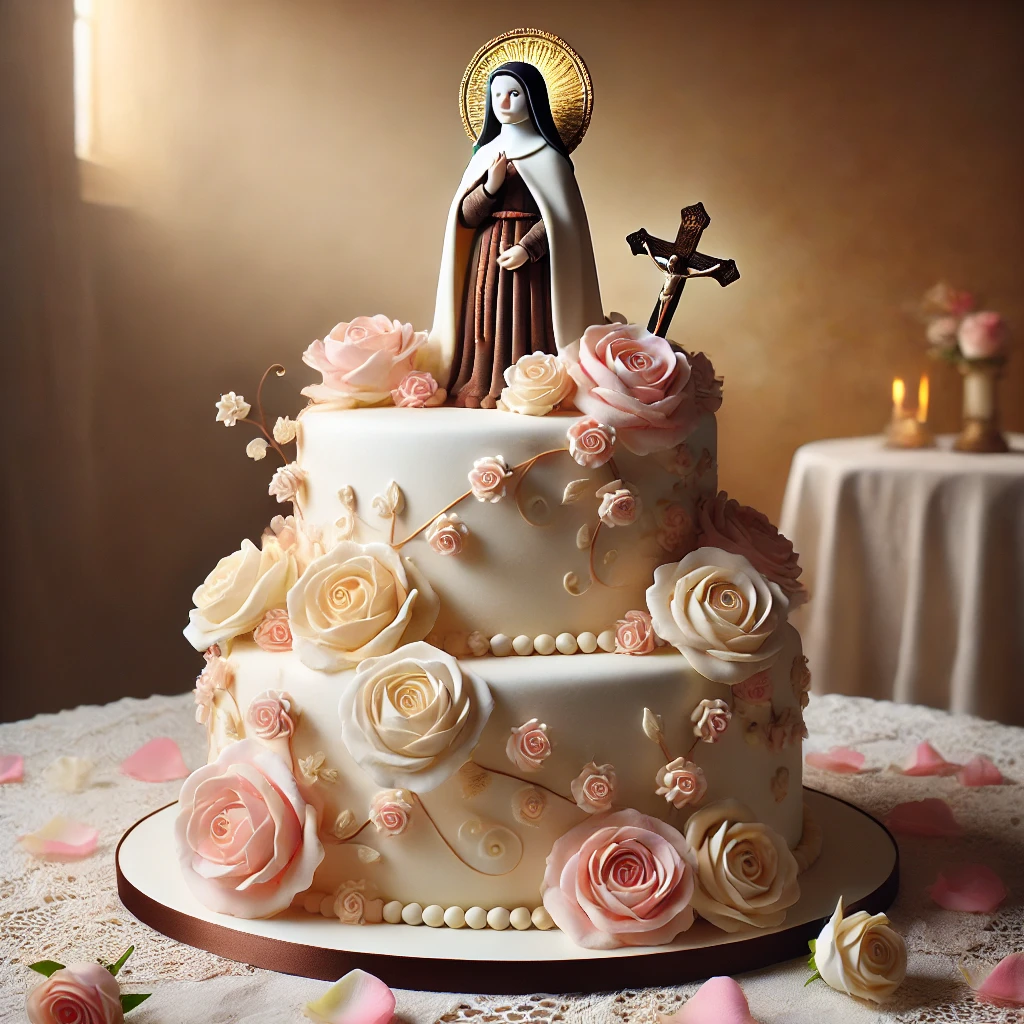
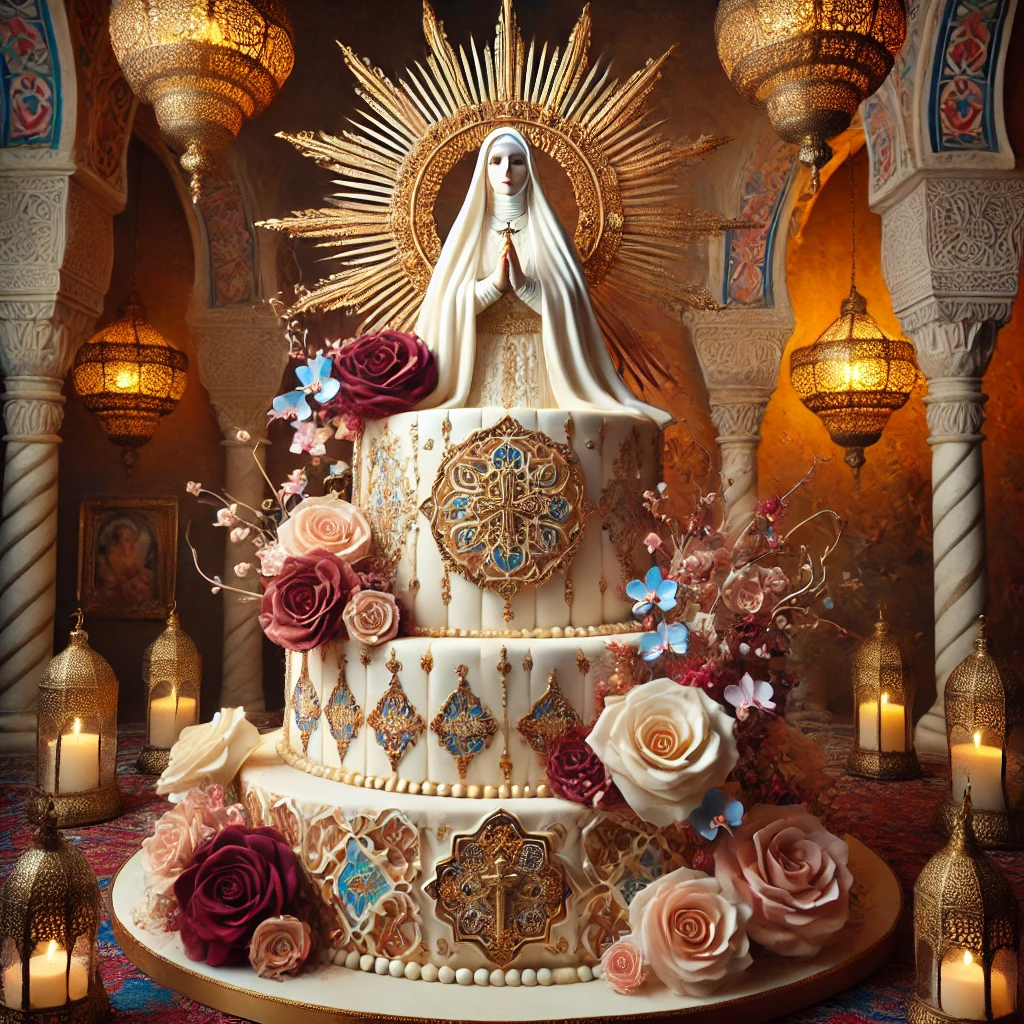
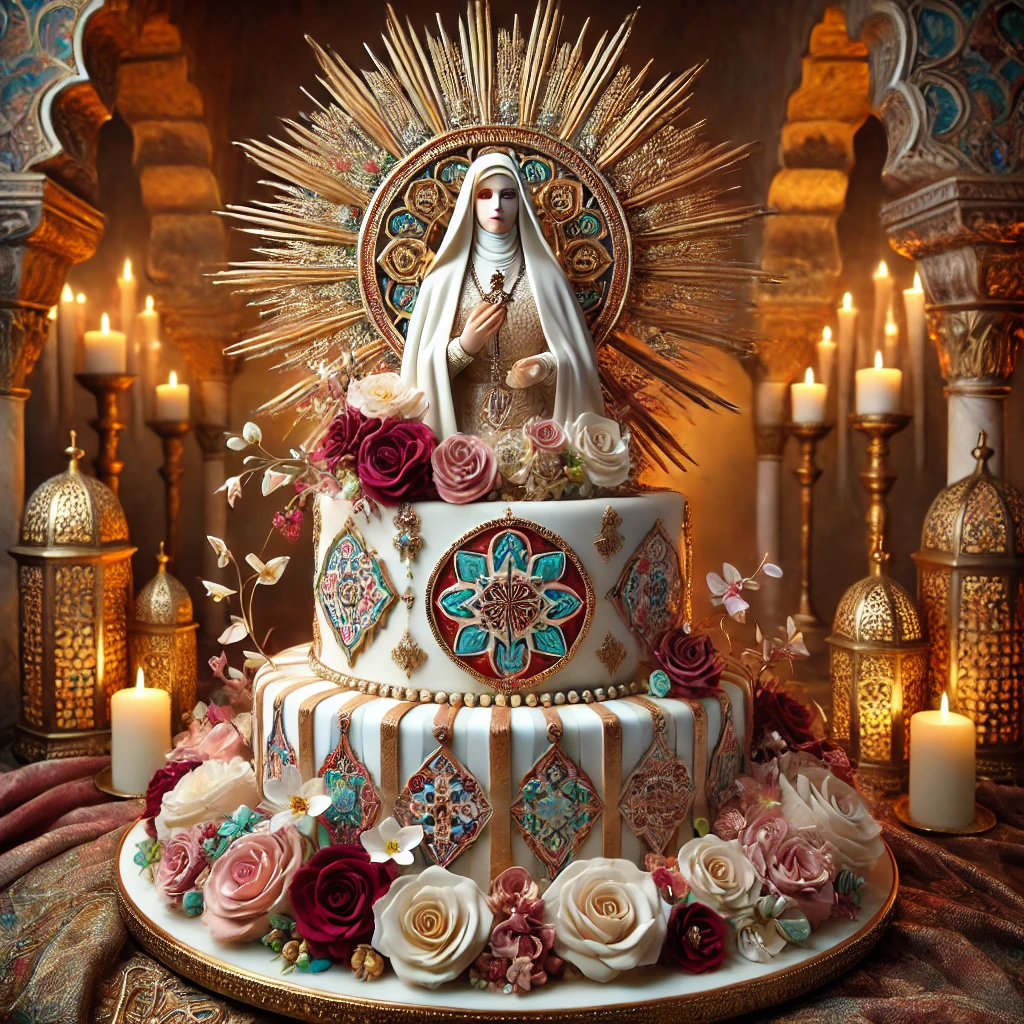
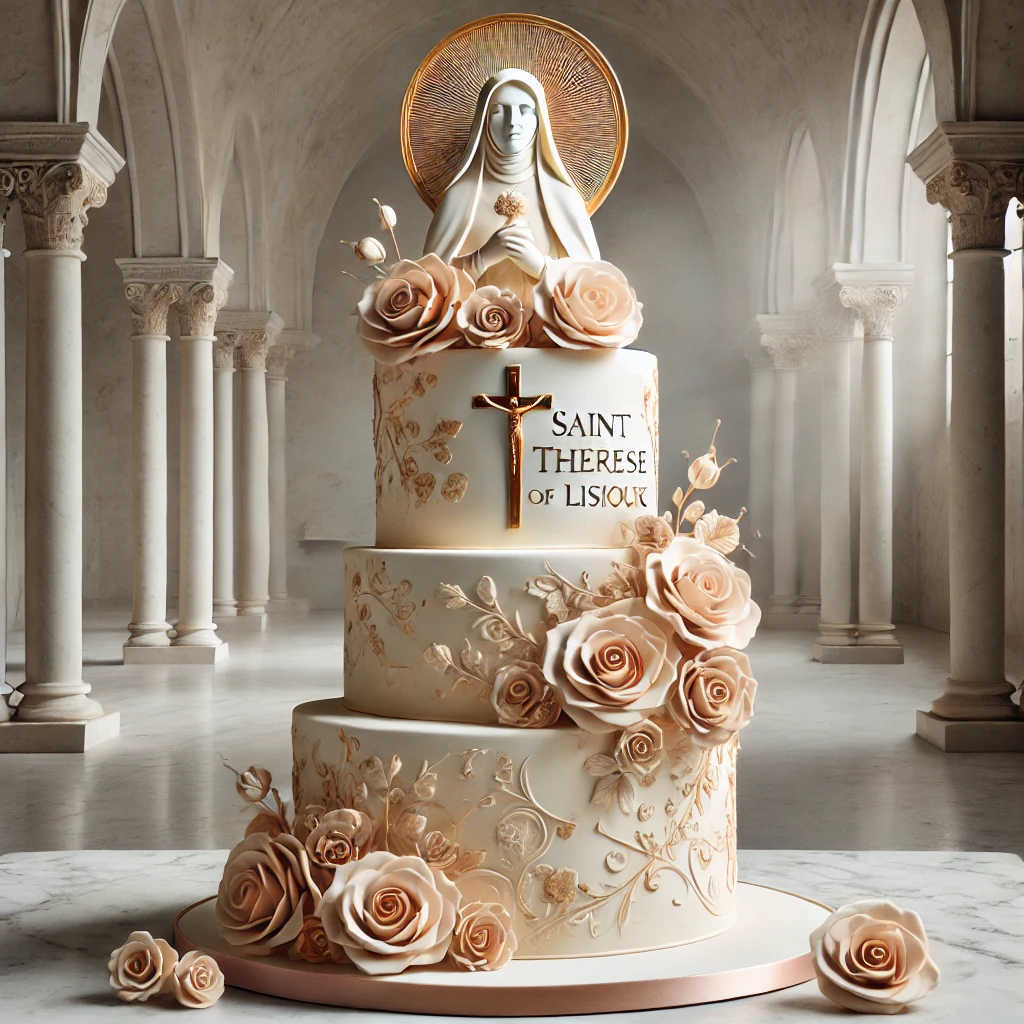
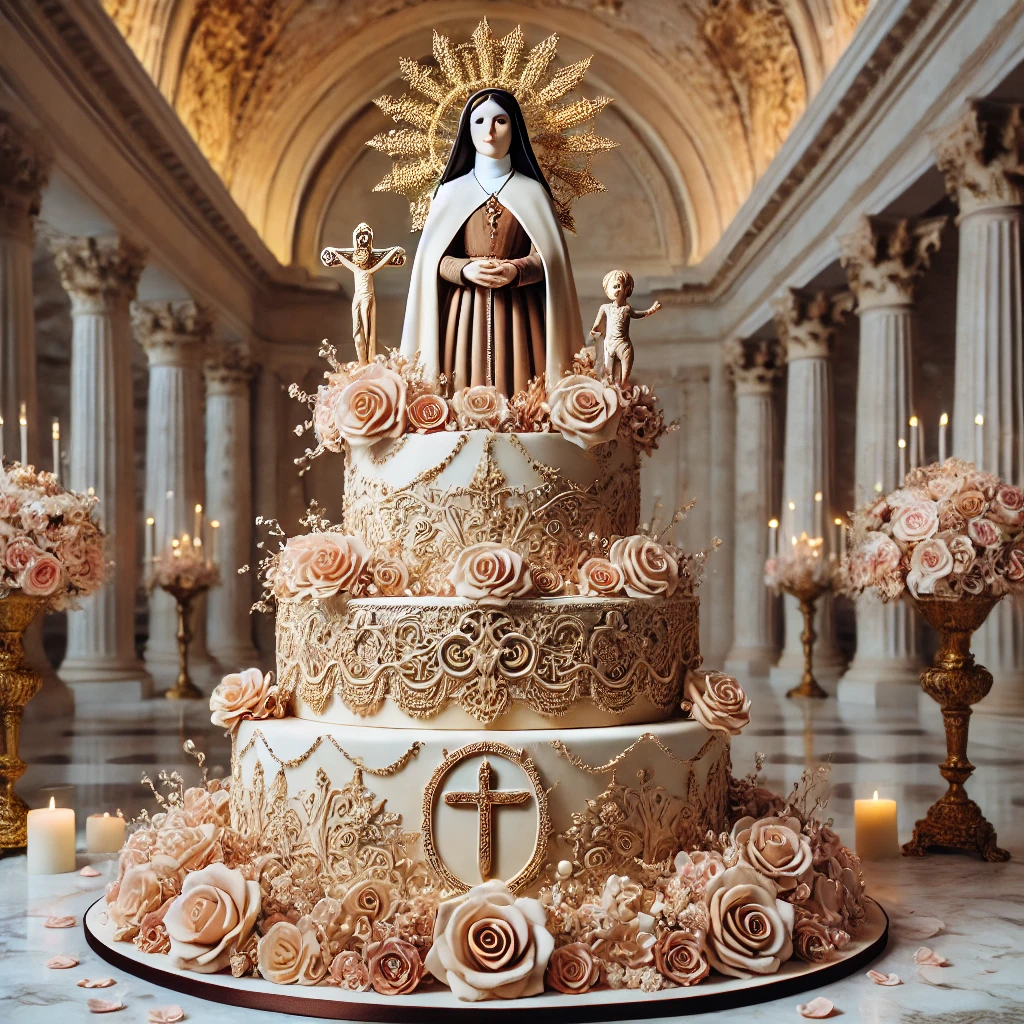
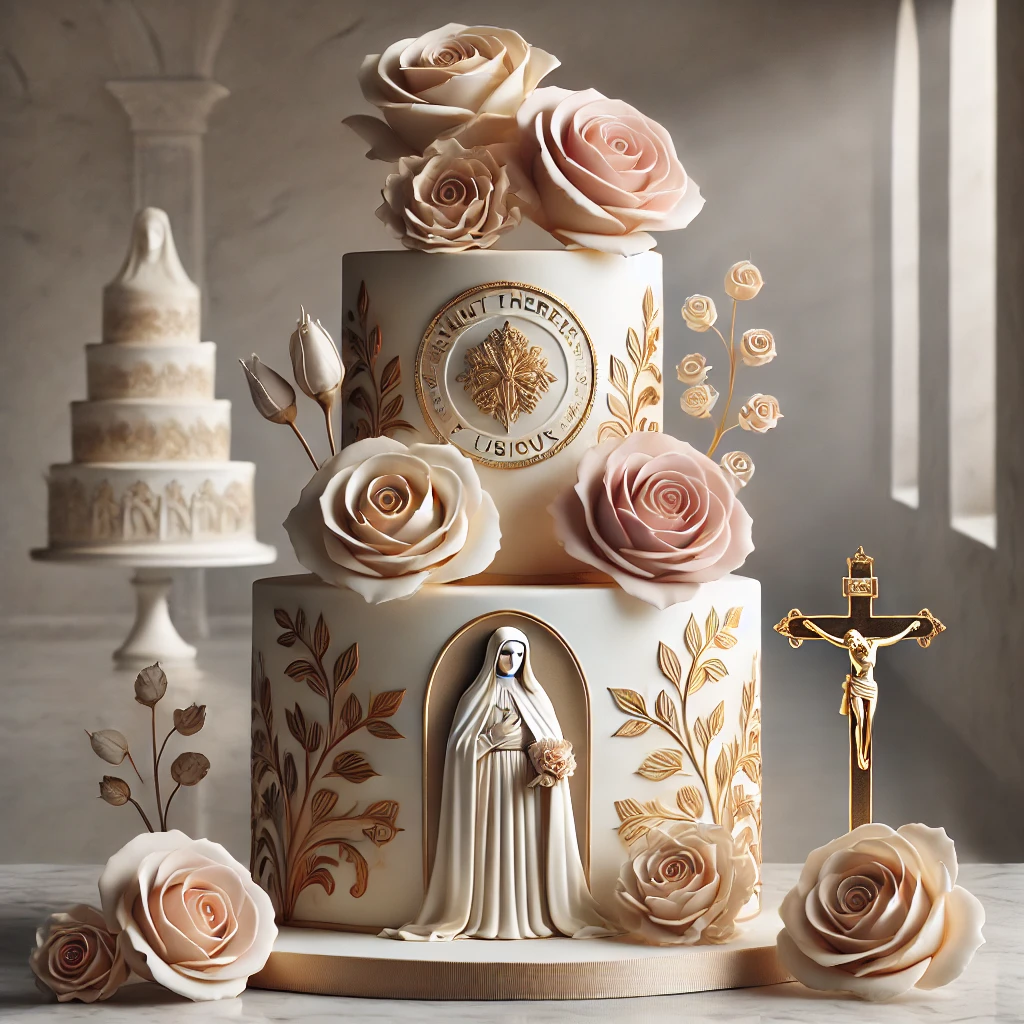
Saint Thérèse of Lisieux Cake & Atmosphere Ideas
Where style, memory, and celebration meet.
This section is meant to be more than Cake Decorating Ideas… it’s designed to spark inspiration and creativity, awaken tradition, and infuse your special occasions with style, identity, and atmosphere. A color palette becomes a theme. A design becomes a mood. Simple details—like sugared holly leaves or shimmering stars—can set the tone for a gathering and become part of cherished traditions and lasting memories melded with personal touch and love.